
Inside the Factory: How We Manufacture Stainless Steel & Titanium Drinkware
Advanced Metal Forming & Vacuum Insulation Technologies: An Enterprise Production Blueprint
How are insulated water bottles and stainless steel tumblers made? The B2B industrial manufacturing process involves 9 automated stages. This blueprint maps our exact execution—from high-tonnage Deep Drawing or Tube Hydroforming raw materials SUS304/316L and pure Titanium, to 570°C Lead-Free Vacuum Sealing and 200°C PFAS-free Powder Coating. For brand procurement, our MOQ starts at 100 units to 3000 units, with timelines scaling from a 15-35 Days fast-track for ODM stock, up to a strict 167-Day lifecycle for OEM private mold rollouts.
🏭 QC & Anti-Intuitive Truth: "Water testing" a steel body is a pseudo-proposition. True leak-proof security is engineered, not guessed. By operating a unified Yongkang foundry, we subject every vessel body to 100% Automated Infrared Thermal Audits (where vacuum failures instantly reveal themselves). We recognize that 99% of actual leaks stem from closure defects—which is why we strictly enforce precision injection tolerances and pressure-relief lid engineering to prevent market recalls.

- 800-TON Hydroforming Force
- INFRARED Vacuum QC Audit
Thermodynamic Engineering: The 6-Hour Phased Vacuum Protocol
The structural longevity of a vacuum insulated cup depends heavily on its thermodynamic heating curve. To execute the critical evacuation stage, Ecoway mandates a strict 6-hour phased vacuuming cycle. While unbalanced 4-hour commodity direct-heating lines fast-ramp straight to 500°C (often resulting in an industry-average 2%-3% vacuum degradation rate due to trapped trace gases), our engineering protocol enforces multi-stage holding temperatures. This ensures complete molecular outgassing of metal pores before fusing the final 570°C Lead-Free glass frit. This process is crucial because true thermodynamic insulation eliminates heat transfer pathways entirely, keeping our factory defect rates below a rigid <1% threshold.
-
Ecoway 6-Hour Phased Cycle
Thermal Profile: Multi-stage ramp-up with stabilization intervals.
Peak Sealing: 570°C via Lead-Free Glass Frit fusion.
Physical Result: Permanent 10⁻⁴ Pa high-vacuum state; absolute compliance with CA Prop 65 lead limits. -
Commodity 4-Hour Direct Cycle
Thermal Profile: Single-stage linear heat spike to 500°C.
Peak Sealing: 500°C using traditional lead solder alloys.
Physical Result: Trapped gas molecules causing rapid vacuum decay to 10⁻² Pa; non-compliant with CA Prop 65 parameters, risking legal liability.
- VACUUM DEGREE: 10⁻⁴ Pa (High Vacuum State)
- ENCAPSULATION: 570°C Lead-Free Frit Fusion
- SYSTEM: Triple-Stage Turbo-Molecular Line
Note for OEM Projects: Before mass production begins, new product development (NPI) requires 48 hours for 3D CAD blueprints, 3–7 days for SLA resin prototypes, and 30–50 days for custom hardened steel tooling. View the full 167-Day OEM timeline here.
9-Step Stainless Steel Tumbler & Cup Manufacturing Process
B2B Technical Workflow: The industrial manufacturing lifecycle integrates 9 automated stages. It begins with high-tonnage shaping—using Tube Hydroforming for contours or Deep Drawing for seamless liners. This is followed by automated necking, Copper Plating, and robotic laser welding. Thermodynamic isolation is secured inside vacuum furnaces via 570°C lead-free glass frit sealing. Crucially, we do not perform standalone "water leak tests" on steel bodies. Why? Because any body defect is instantly detected during our 100% Automated Infrared Thermal Audit. True leaks arise from closure defects in Step 8—prevented by our strict pressure-relief lid engineering protocols. The condensed execution steps follow below:
- Step 01. Steel Forming & Shaping Converting raw SUS304 or SUS316L into outer & inner bodies via Hydroforming or Deep Drawing to precise 0.20-1.00mm wall gauges.
- Step 02. Precision Necking & Threading Compression necking to exact diameters and rolling threads with ±0.05mm injection tolerance for a precise cap interface.
- Step 03. Copper Shield Lining Applying an electro-plated copper barrier to reduce radiant heat loss and boost thermal retention by 10%–15%.
- Step 04. Automated Laser Welding Fusing outer shells and bottom covers using multi-axis robotic fiber laser cells in an inert gas environment.
- Step 05. 6-Hour Vacuum Brazing Executing the 6-Hour Phased Vacuum Cycle down to 10⁻⁴ Pa with 570°C Lead-Free Glass Frit Sealing (CA Prop 65 safe).
- Step 06. Electrochemical Passivation Internal electrolytic polishing and optional 300°C+ sol-gel ceramic inner coating for metallic-free flavor purity.
- Step 07. Surface Polishing & Coating Mechanical pre-polishing followed by 200°C PFAS-free Powder Coating, PVD Plating, or 360° UV Printing.
- Step 08. Component Injection Molding (The Leak-Proof Check) Multi-cavity injection of BPA-Free Eastman Tritan™ and PP lids and silicone gaskets. This stage dictates leak prevention.
- Step 09. Final Assembly & Comprehensive QA Cleanroom component assembly, 100% automated infrared thermal imaging (verifying absolute vacuum integrity), final AQL sorting, and DDP packing.
Sourcing Specialist Note:
Understanding the stainless steel thermos flask manufacturing process helps brand owners optimize BOM costs. Choosing Hydroforming (Stanley style) vs. Deep Drawing (Yeti style) directly impacts tooling CapEx and silhouette complexity. We outline exact tooling costs in the static matrix below.

Forming Comparison: Yeti vs. Stanley
| Primary Tech | Target Style & Advantage |
|---|---|
| Hydroforming | Stanley/Owala Style: Complex ergonomic curves & car-cup bases. |
| Deep Drawing | YETI Style: 100% seamless rugged interior; handles thicker steel gauges. |
Request Technical DFM Audit & Tooling Cost Quotation
Submit technical production drawings (STEP, IGES, or CAD PDF) or AI concept sketches directly to the Yongkang engineering office. The engineering team delivers a factory-direct DFM feasibility report and cost sheet within 24 hours.
Executive Summary & 9-Step Engineering Protocol
Ecoway Houseware executes hydration vessel manufacturing under unified B2B quality standards, guaranteeing 100% authentic SUS304/SUS316L stainless steel and Grade 1 Titanium. Utilizing 570°C high-temperature glass frit vacuum sealing, our Yongkang foundry delivers lead-free California Proposition 65 compliance, 100% inline infrared QC inspection (<1% defect rate), and a 1-year 1:1 replacement warranty across custom OEM/ODM production runs.
Material Compliance & Quality Standards (TL;DR)
Executing hydration vessel rollouts requires strict adherence to international safety metrics. At Ecoway Houseware, our Yongkang factory operates under a unified standard for all B2B brands, actively welcoming SGS/TÜV Third-Party Inspections (TPI) to verify our data.
- Material Allocation: 100% Authentic SUS304 (PREN 19.0), SUS316L (PREN 24.5) & Pure Grade 1 Titanium.
- Lead-Free Guarantee: Absolute compliance with California Prop 65 via 570°C high-temperature glass frit fusion isolation.
- Risk-Free Quality Control Execution: Deployment of AQL 2.5/4.0, 100% inline infrared verification (<1% defect rate), and an official 1-Year 1:1 Replacement Warranty.
Develop engineering alternatives for Stanley | Yeti | Hydro Flask | Owala.
The 9-Step Manufacturing Engineering Protocol
Engineering a hydration vessel requires precise control of metallurgical physics and heavy-tonnage hydraulic machinery. Ecoway Houseware operates a unified, zero-subcontracting manufacturing protocol. From 0.20mm to 1.00mm heavy-duty execution to 10⁻⁴ Pa high-vacuum brazing curves, this step-by-step documentation details active industrial standards required to transform raw SUS304/316L medical-grade alloys into stable, retail-ready brand assets.
-
01. MATERIAL SELECTION & SHELL FORMING
Following the completion of NPI requirements (including 3D CAD modeling, SLA prototyping, and bespoke CNC mold fabrication), active mass production begins with audited raw material substrates. Our fabrication facility sources pure metallurgical grades to align with your structural safety requirements, verified against our Master Material Standards via PMI Spectrometry.
- SUS 304 (18/8): The standard metallurgical specification for food-grade safety and oxidation resistance.
- SUS 316L (Medical Grade): Elevated molybdenum integration providing acid resistance for complex organic liquid compounds.
- Pure Titanium (Grade 1): High-purity aerospace-grade metallic structure, delivering a 45% weight reduction relative to steel with zero flavor carryover.
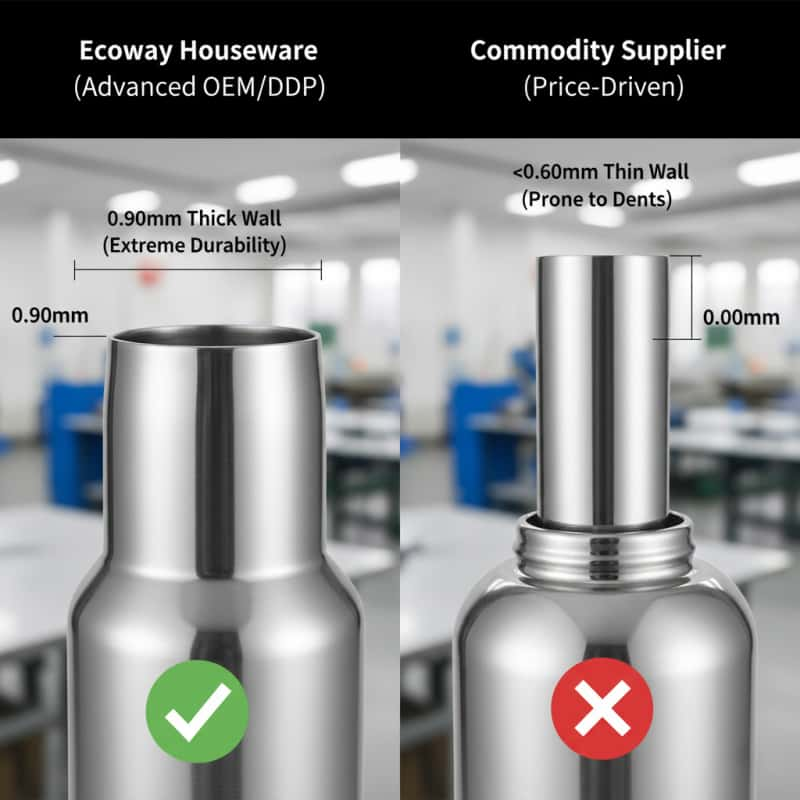
Steel Gauge (Thickness) Specifications MatrixSteel Gauge and Wall Thickness Interval Specifications Wall Classification Thickness Interval Ultra-Lightweight Thin Inner Wall 0.20mm - 0.30mm Regular Commodity Standard Thickness 0.40mm - 0.50mm Ecoway Heavy-Duty Capability 0.60mm - 1.00mm Armor-Wall™ (Maximum dent resistance) Converting flat steel discs or cylindrical welded pipes into double-wall insulated architectures requires high-tonnage precision tooling configured to one of two structural mechanical workflows:
METHOD A: Deep Drawing (The Seamless Interior Process)
A flat stainless steel disc is subjected to progressive punching stages by a hydraulic press line. This creates a 100% Seamless Interior, eliminating bacterial accumulation zones—a baseline parameter for YETI-style vacuum vessels.
🛠️ DFM Engineering Note:To execute structural lightweighting without inducing vacuum chamber implosion, we apply CNC Spinning technology to thin the inner liner wall to a precision threshold of 0.20mm - 0.30mm, reducing mass by 30% while securing structural integrity constants.

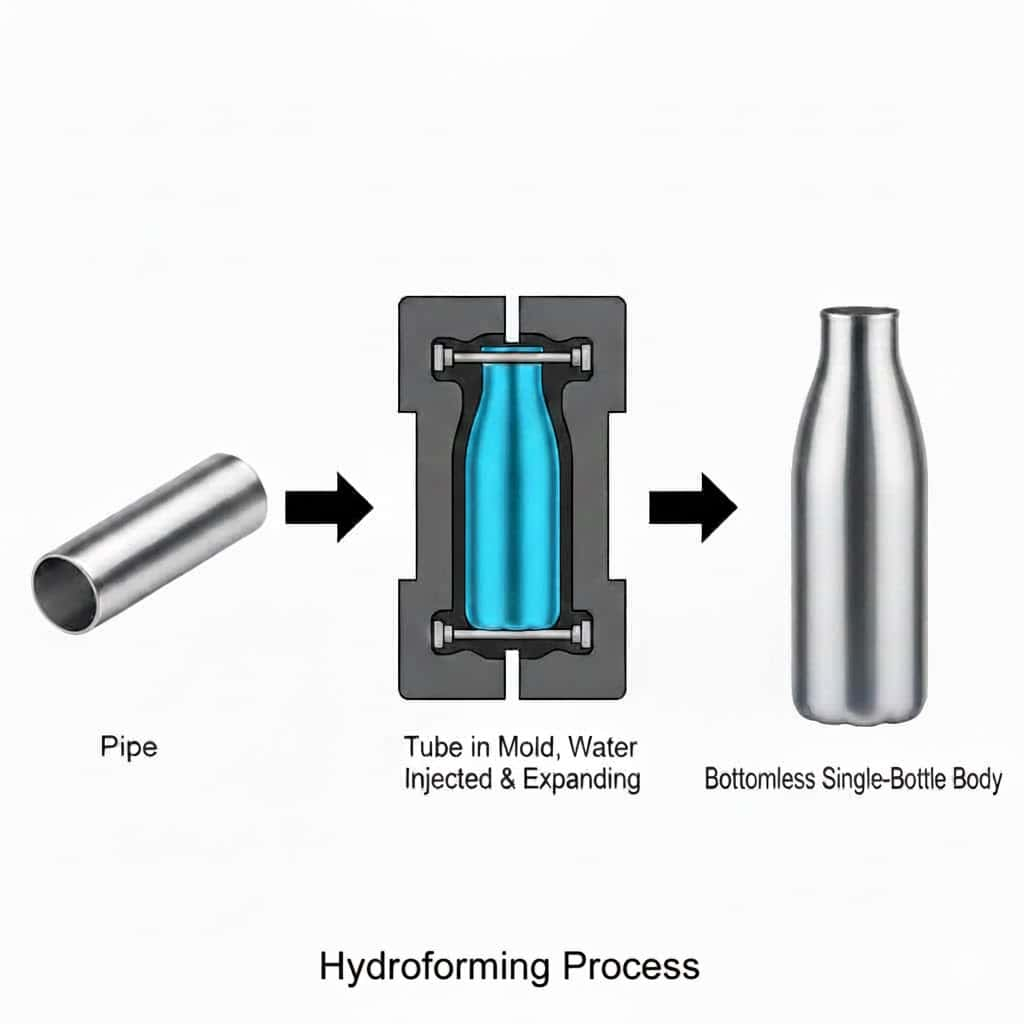
METHOD B: Tube Hydroforming (High-Pressure Fluid Expansion)
A welded steel cylinder is secured within a hardened die block and expanded outward via high-pressure hydraulic fluid. This enables precise geometric execution for complex contours and car-cup compatible tapered bases (Stanley/Owala style).
-
02. PRECISION NECKING & THREADING
Precision Necking & Threading Roll
The container mouth is compressed via rotary necking machinery to strict millimeter tolerances before screw threads are rolled. This enforces a 100% leak-proof interface with ±0.05mm injection tolerance lid assemblies, eliminating thread slippage and alignment variance.
Factory Action: Forming & Manufacturing In Progress⚙️ Industry Technology Matrix
Drinkware Manufacturing Industry Technology Matrix Criteria Stanley Form Factor Yeti Form Factor Hydro Flask Form Factor Primary Tech Tube Hydroforming Deep Drawing Lightweight Hydroforming Design Priority Complex Geometric Curves 100% Seamless Interior Lightweight Portability Matrix Steel Gauge Constant 0.5mm 0.6mm - 0.65mm 0.4mm -
03. THERMAL RADIATION COPPER LINING
Advanced Copper Shielding Deployment
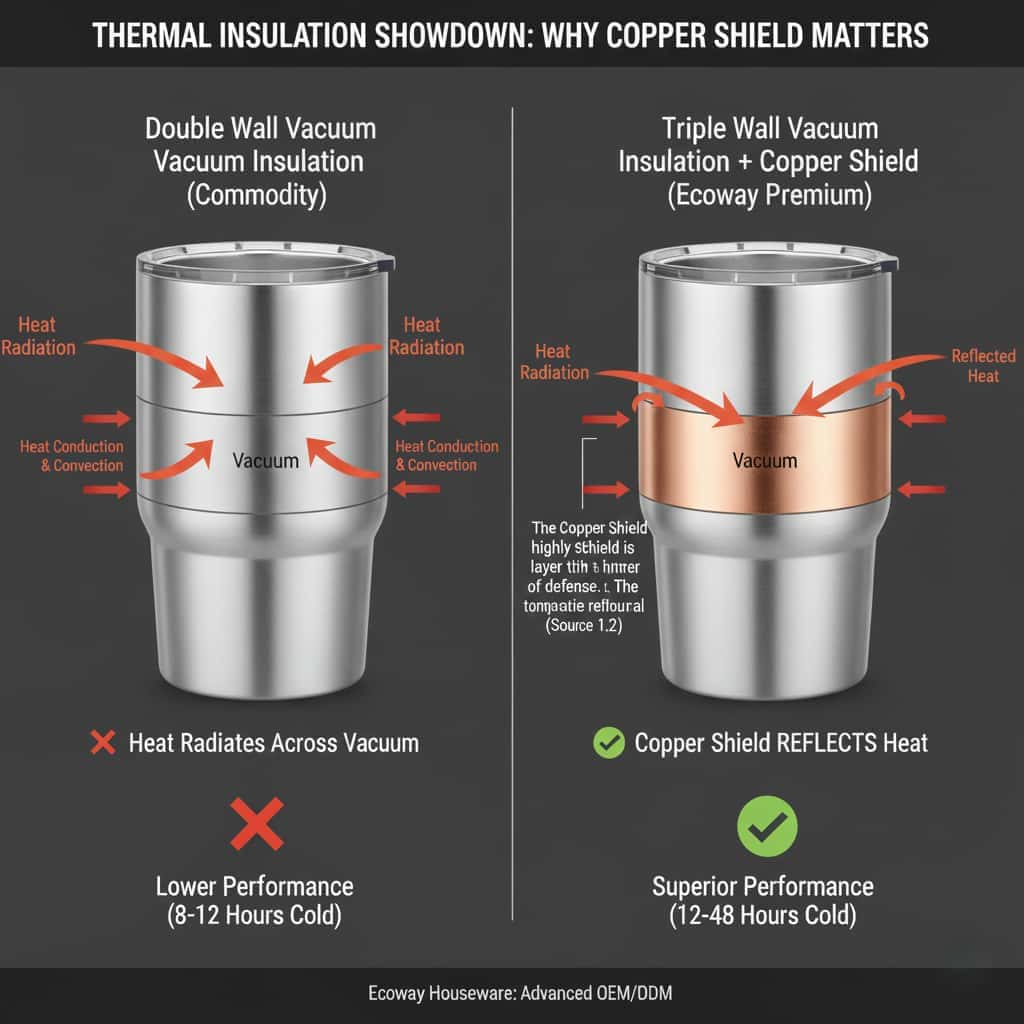
Prior to multi-wall assembly synchronization, the exterior surface of the inner steel shell undergoes automated electro-plating to deploy a copper reflection layer. This metallic shield functions as a thermodynamic mirror, reflecting infrared radiation and reducing overall emissivity. The integrated copper lining layer directly induces a 10% to 15% increase in total thermal retention performance. Implementing this configuration carries a calculated unit cost variable of $0.10 to $0.15 USD per vessel, evaluated dynamically within our B2B Manufacturing Cost Breakdown Hub.
ENGINEERING PRINCIPLE: THE STEFAN-BOLTZMANN LAW
The rate of radiant heat transfer is minimized through high-temperature vacuum brazing according to the governing relation:
P = εσA(T⁴ − T₄⁴)[ ε = Emissivity | σ = Stefan-Boltzmann Constant | A = Radiating Surface Area ]Result: The electro-plated copper barrier reduces radiant energy dissipation by more than 95% relative to non-plated alternative vessels.
-
04. AUTOMATED ROBOTIC LASER WELDING
Robotic Fiber Laser Seam Fusion
Ecoway coordinates an automated multi-axis robotic fiber laser cell to fuse container mouth seams and bottom enclosure plates. Precision laser alignment maintains a narrow heat-affected zone (HAZ), securing joint tolerances and providing structural resistance to mechanical shock testing. This airtight seal provides the required baseline structural framework for high-vacuum longevity, mitigating micro-porosity failure variables across large-scale production cycles.
-
05. HIGH-TEMPERATURE VACUUM BRAZING
The 6-Hour Phased Vacuum Extraction
Fused components are routed through a multi-zone vacuum furnace operating a strict 6-hour phased vacuuming curve down to a 10⁻⁴ Pa high-vacuum state. Gradual thermal holding periods secure outgassing of trace gases trapped within the alloy grain boundaries. To form a stable hermetic seal, Ecoway executes a 570°C Lead-Free Glass Frit Sealing process.
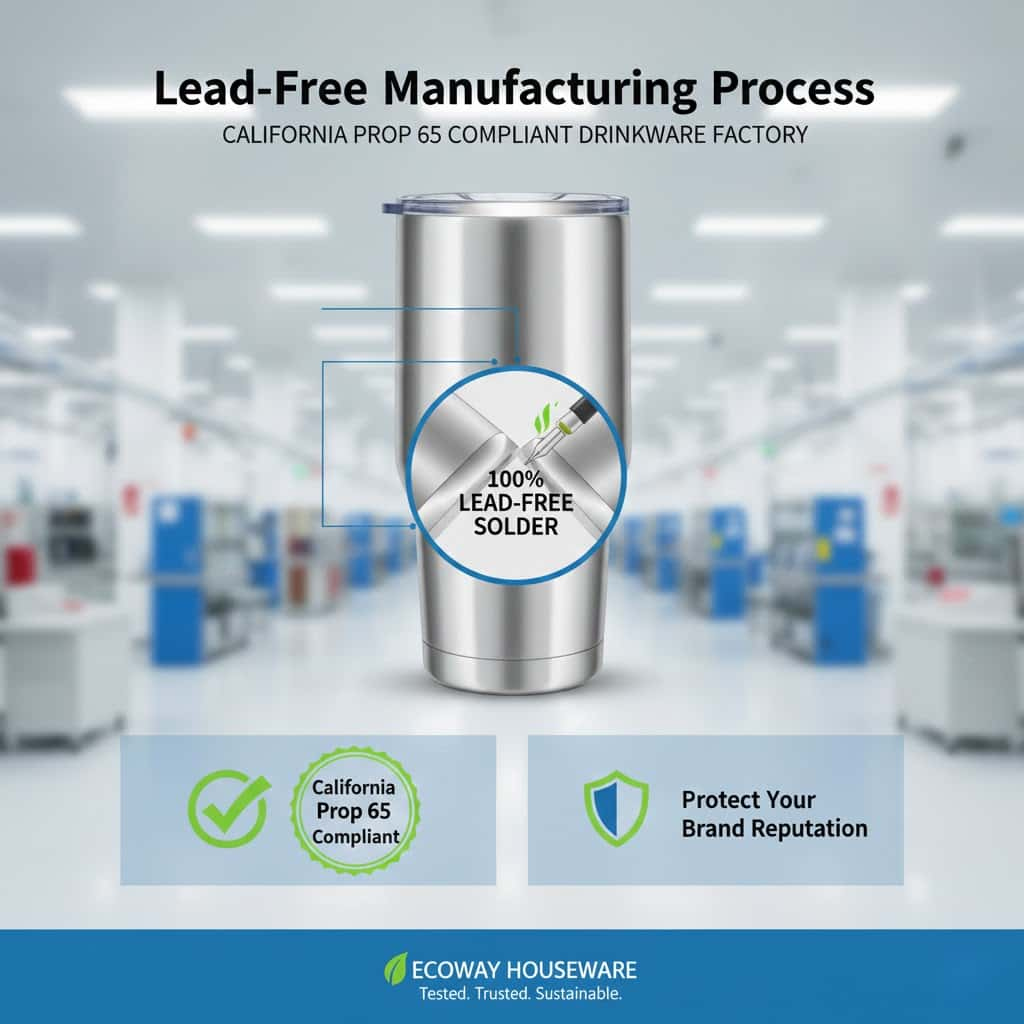
⚠️ Prop 65 Compliance Warning: Fusing microscopic glass particles establishes a stable, non-toxic seal that completely eliminates the severe California Prop 65 heavy metal litigation risks associated with traditional lead-solder beads used by commodity factories.
-
06. INTERNAL ELECTROLYSIS PASSIVATION & CERAMIC COATING
Internal Electrolysis Passivation
The interior liner surface undergoes electrolysis passivation to remove free iron particles, establishing a chromium-rich passive safety film that resists organic acid corrosion.
⚠️ Quality Control: Anti-Rust Validation
Omitting passivation accelerates oxidation pathways. Ecoway validates material structural resilience by subjecting batch samples to standard ASTM B117 / ISO 9227 Salt Spray Testing constants to certify corrosion resistance.
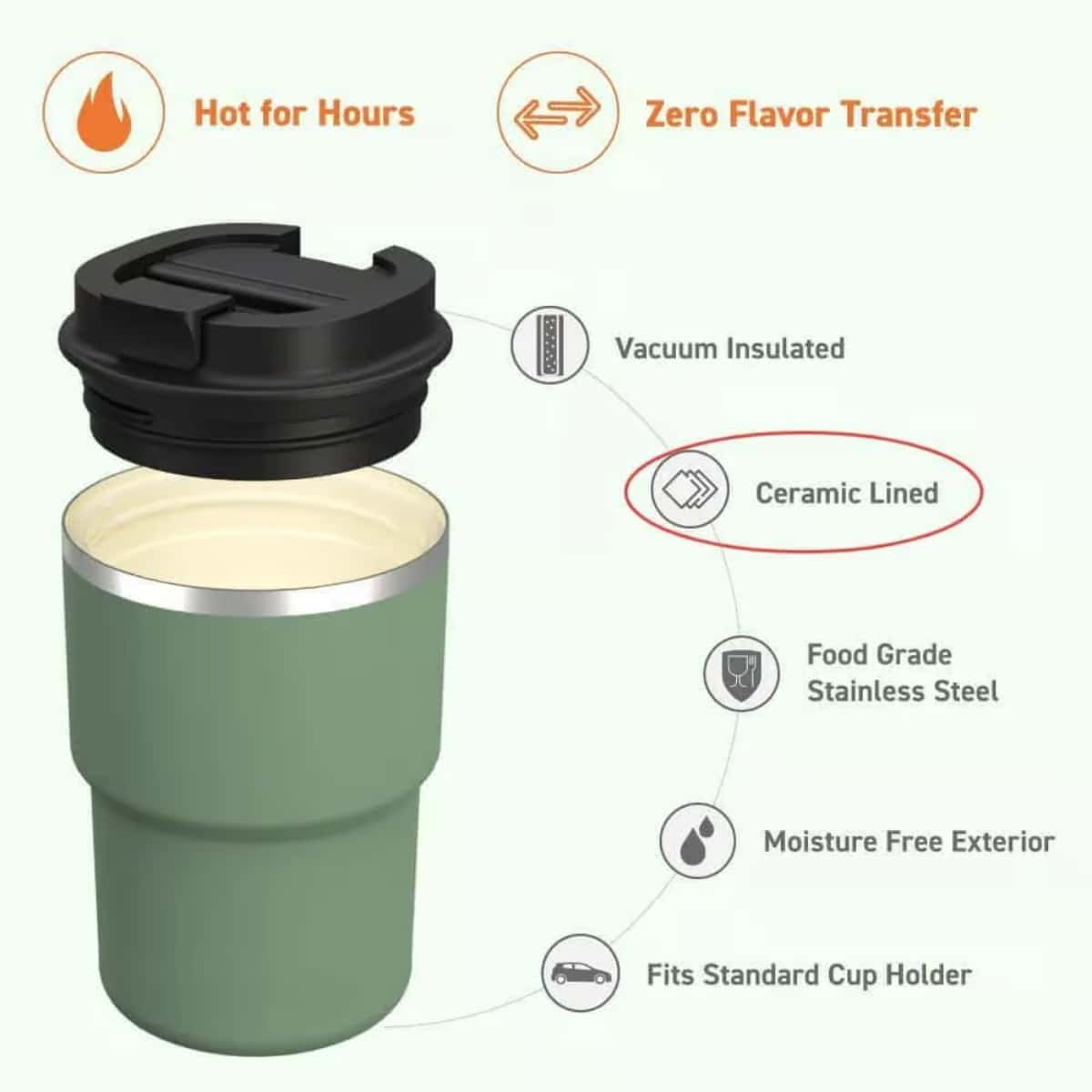
Sol-Gel Ceramic Lining (+$0.50-$1.00 USD)
For specialty beverage and craft brewing specifications demanding flavor isolation, we apply a non-metallic Sol-Gel Ceramic Coating Layer uniformly via automated high-pressure spray atomization. Following thermal curing processing exceeding 300°C, the cross-linked coating merges with the SUS304 substrate to resist staining and prevent metallic flavor carryover. This parameter carries a dynamic cost delta of +$0.50 to +$1.00 USD per unit based on size capacity. Explore Sol-Gel Specifications.
-
07. EXTERIOR POLISHING & SURFACE COATING
This phase processes raw structural cores into customized retail assets utilizing high-adhesion finishing lines. Explore all custom branding solutions.
Exterior Finish Classification and Performance Profile Specs Exterior Finish Classification Performance Profile & Aesthetic Specification Polishing Pre-Treatment Baseline mechanical abrasive processing. Configured in Mirror Polish or Satin/Matte modalities to remove surface micro-imperfections prior to pigment application. Spray Painting Liquid fluid coating application. Achieves high gloss indexes and standard Pantone color matching parameters for commercial product lines. Powder Coating High-temperature cured (200°C - 220°C) cross-linked polyester resin layer. Yields a textured surface with scratch resistance, securing heavy-metal free and 100% PFAS-free compliance. Rubber Coating Tactile soft-touch finish. Imparts a slip-resistant polymer outer layer to eliminate surface condensation movement while increasing unit perceived value. PVD Coating Physical Vapor Deposition molecular bonding. Formulates ultra-hard decorative metallic compound coatings including Gold, Rose Gold, and spectrum options. 
Precision Logo Integration Equipment
To ensure corporate identity metrics withstand extended wear environments, we deploy synchronized branding equipment:
- Laser Engraving: Multi-axis fiber laser systems vaporize surface coatings to expose the steel substrate to sub-millimeter precision tolerances. Permanent and abrasion-resistant.
- Silk-screen Printing: Linear mechanical ink transfer optimized for bulk manufacturing volume efficiency with exact Pantone index reproduction.
- 3D UV Printing: Direct digital inkjet deployment supporting complete color gradients and tactile multi-layer embossed structural profiles.
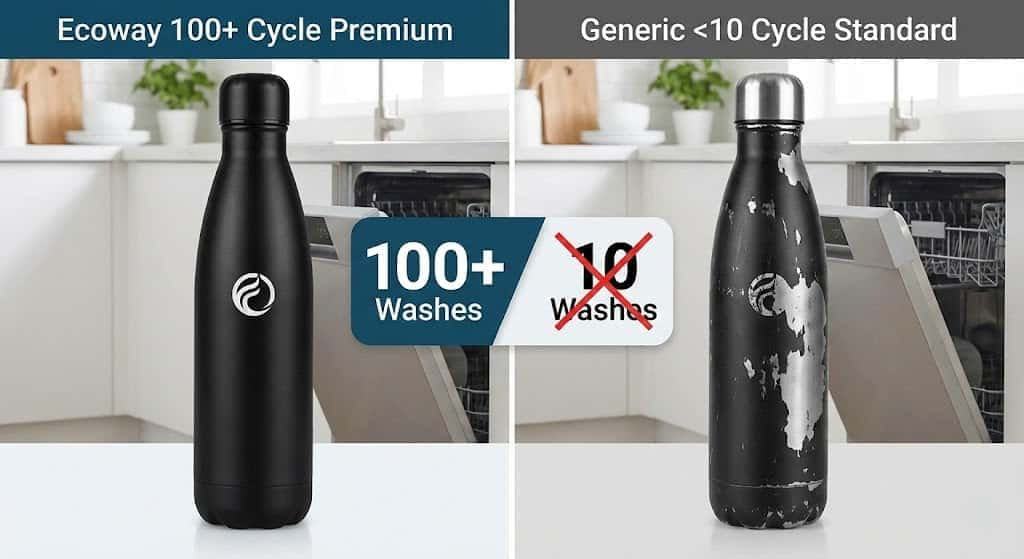
TESTING STANDARD: The "100 Cycle" Dishwasher Safe Check
Our exterior PFAS-free powder resin formulas are processed through high-temperature 200°C - 220°C curing zones to pass rigid ASTM D3359 Grade 5B cross-hatch tape adhesion tests and withstand 100+ caustic commercial wash testing cycles without displaying delamination or paint loss.
-
08. COMPONENT INJECTION MOLDING
Accessories, closures, and sealing interfaces conform to strict physical-mechanical metrics with ±0.05mm injection tolerance to prevent thread stripping and secure vacuum integrity constants.
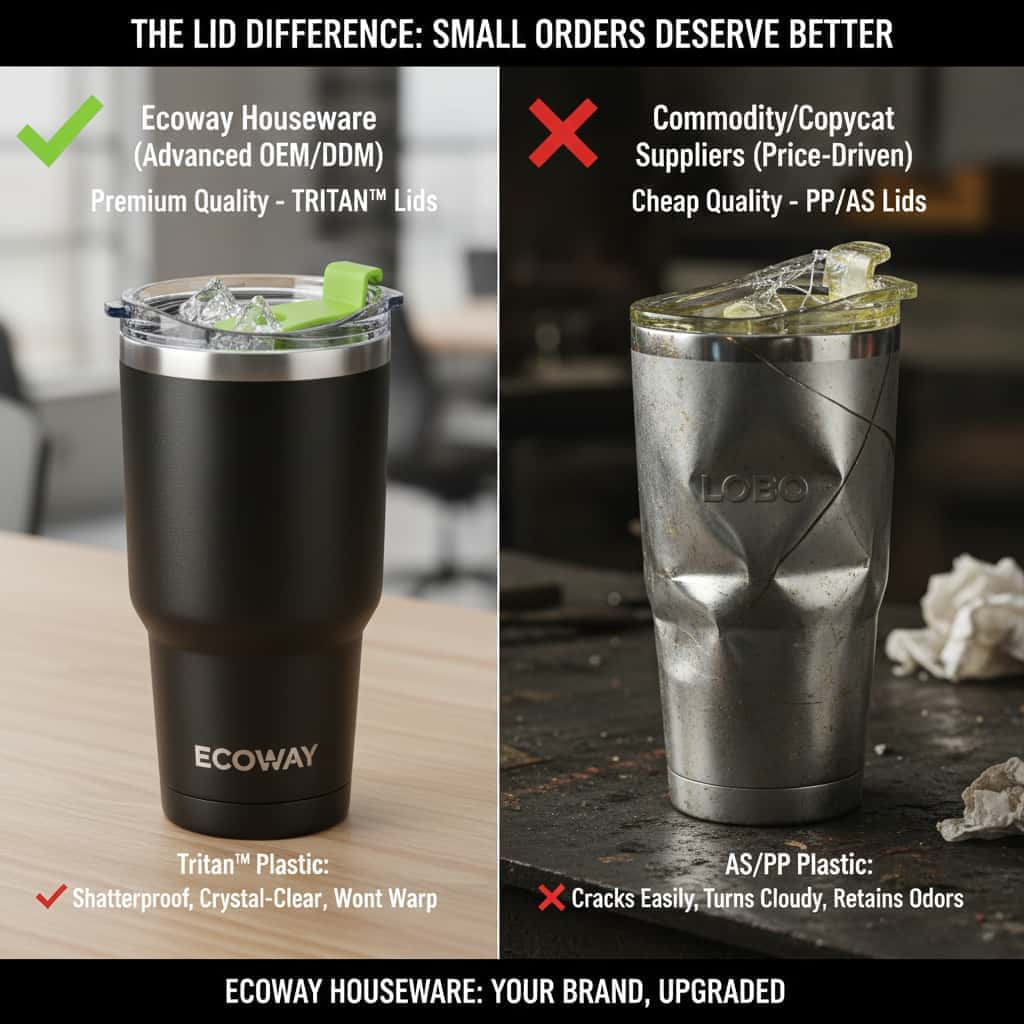
Eastman Tritan™ Copolyester Closure Standardization
Ecoway mandates 100% BPA-free Eastman Tritan™ Copolyester for transparent lid structures, sliders, and straw mechanisms. Unlike generic AS/PS polymers susceptible to environmental stress cracking and odor retention under high-temperature washing, Tritan maintains clear optical properties and impact performance. For integrated soft components, we utilize dual-injection overmolding equipment to fuse elastic TPE directly to structural PP frameworks without chemical adhesives, securing raw purity standards.
-
09. FINAL ASSEMBLY, COMPREHENSIVE QA & LOGISTICS
🏭 Industry Truth: Why We Don't "Water Test" Steel Bodies for Leaks
A common misconception is that factories dunk steel bodies in water tanks to check for leaks. This is absolutely false. A steel body that leaks water will absolutely leak air. Any weld defect means it will instantly fail our 100% Automated Infrared Thermal Audit (designed to detect vacuum loss). If a cup passes the vacuum thermal test, the steel body is inherently 100% leak-proof.
Preventing Actual Leaks via Lid Engineering
99% of consumer leak complaints arise from Step 8: Component Injection Molding. Defective lids utilizing cheap plastics shrink under hot water pressure, or utilize improperly calculated silicone gaskets. Furthermore, some lids (like the original Stanley Quencher) are simply not designed to be 100% leak-proof.
Ecoway mandates Eastman Tritan™ Copolyester and precision TPE overmolding to prevent thermal shrinkage. True leak prevention is secured during the DFM blueprint phase. Read our engineering guide on preventing water bottle recalls and lid leaks.
100% Comprehensive Inspection Protocols
Before packaging execution, every unit routes through an integrated quality checkpoint array:
- Automated Infrared Thermal Audit: Vessels travel through a hot-air blast tunnel monitored by digital infrared thermal cameras. Units demonstrating thermal conductivity to the outer shell are instantly rejected, preserving a strict <1% vacuum degradation rate threshold. View thermal baseline specs.
- Adhesion Cross-Hatch Testing: Production batch checks execute grid cuts with ASTM D3359 5B cross-hatch tape validation systems to confirm coating bond durability.
- MIL-STD-105E Final AQL 2.5/4.0: Rigid final inspection audits color variation tolerances (Delta E limits), package structural layout, and invokes our 1-Year 1:1 Defect Replacement Warranty.
🌿 ISTA-Tested Sustainable Fulfillment & DDP Logistics
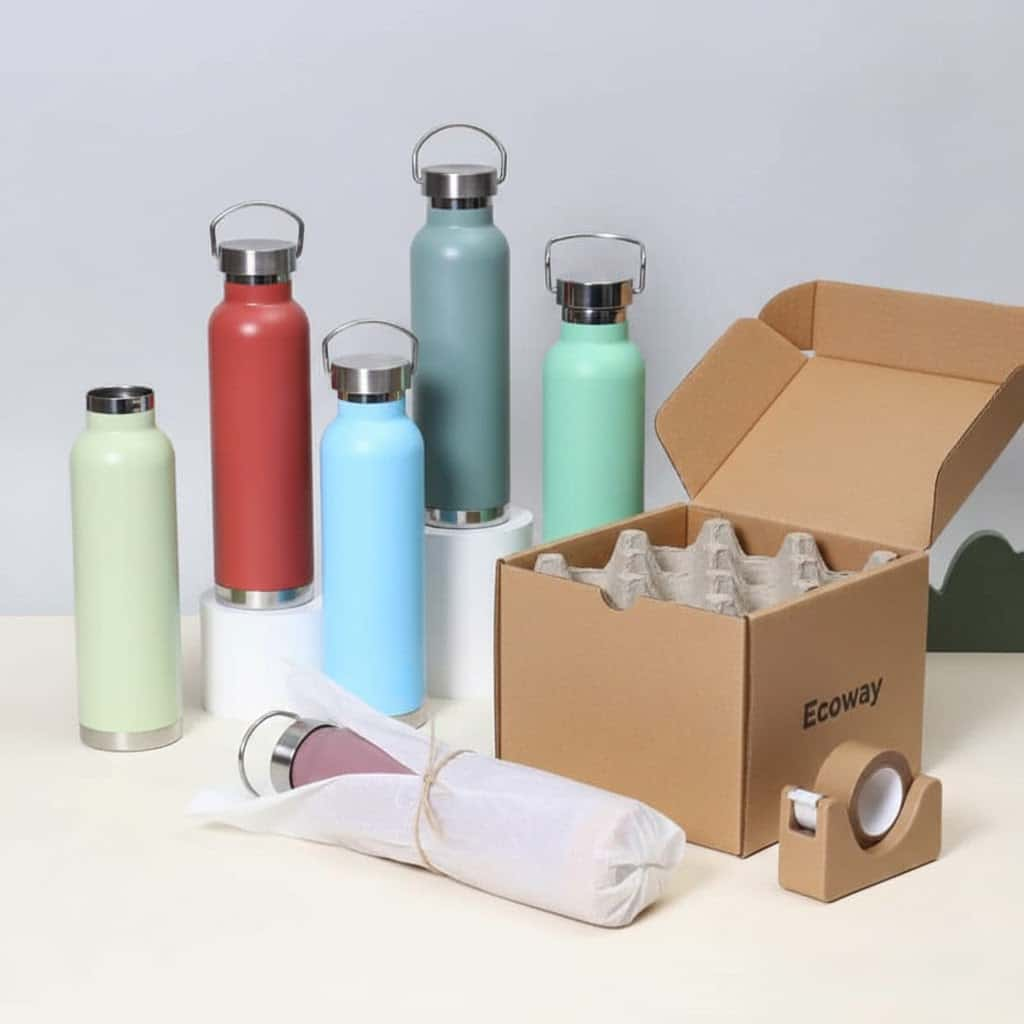
Ecoway coordinates plastic-free logistics profiles using FSC-certified honeycomb protective sleeves and K=K double-wall corrugated fiberboard. Export master cartons are engineered to fulfill ISTA 1A / 3A Drop Testing specifications (surviving 10 free-fall drops from 30 inches), preventing maritime transport transit degradation. Our integrated logistics department manages complete DDP Logistics solutions across USA, EU, UK, LATAM, and Australian corridors, executing import customs processing and prepaid duty structures directly to your destination dock or Amazon FBA hub.
B2B Drinkware DFM & Cost Engine
Industrial pricing model mapped for global procurement. Dynamically estimate structural mold CapEx and DDP unit costs for standard 24oz vessels vs. trending 40oz Handled Tumblers.
The Ecoway B2B Drinkware DFM and Cost Engine calculates tooling CapEx and landed DDP unit costs for 24oz vacuum bottles and 40oz handled tumblers. It evaluates hydroforming versus deep drawing tooling, lid co-injection sets, SUS304/SUS316L/Titanium metallurgy, and lead-free vacuum sealing. Estimates incorporate real-time alloy pricing indexes and DDP logistics to deliver accurate production cost audits.
B2B Manufacturing Process Costs & Metallurgical Benchmark Matrix
*Comprehensive static reference matrix mapping forming processes, lid system tooling, metallurgy grades, performance barrier additions, and DDP shipping for automated procurement indexing. Includes dynamic adjustments for 40oz handled variants.
| Forming & Customization Process | Metallurgy & Technical Spec | Tooling CapEx / Add-on Cost | Key Technical Benchmark |
|---|---|---|---|
| 24oz Custom Hydroforming Body | SUS304 Steel | $2,500 USD CapEx | High-pressure hydraulic expansion shaping |
| 40oz Handled Tumbler (Stanley Style) | SUS304 Steel | $6,000 USD CapEx (Base + Handle) | Double-wall hydroforming expansion + Laser Spot Welding |
| Magnetic Slider Lid Injection Tooling | AS Polymer + Magnet | $9,500 USD CapEx | S136 steel mold, spill-resistant magnetic slider |
| Custom 2-Shot Lid Co-Injection (Owala Style) | PP + TPE Copolymer | $32,500+ USD CapEx | Dual-material leak-proof sealing, 2-shot automation |
| Sol-Gel SiO2 Ceramic Inner Coating | Surface Treatment | +$0.50 to +$1.00 USD / pc (Capacity Dependent) | 300°C baked non-metallic flavor barrier shield |
| 40oz Handled Tumbler (EXW Base Cost) | Unit BOM Cost | Base $5.12 USD / pc (Before Customizations) | High-capacity baseline unit BOM specification |
FAQ: Metal Bottle Manufacturing Processes & Technology
Engineering insights for B2B procurement, product developers, and brand owners.
Ecoway Houseware provides technical answers regarding B2B drinkware manufacturing, custom tooling timelines, lead-free vacuum insulation, and material safety compliance. Operating in Yongkang, China, our automated factory utilizes hydroforming, progressive deep drawing, robotic laser welding, 570°C glass frit sealing, and 300°C ceramic inner lining to manufacture wholesale stainless steel tumblers and titanium water bottles.
1. Metal Forming & Welding
-
What is the technical difference between manufacturing a Yeti tumbler versus a Stanley cup?
Forming TechnologyThe core difference lies in the metal expansion technique. Yeti-style tumblers utilize Deep Drawing to establish a 100% seamless straight-walled interior with an Armor-Wall thickness range of 0.60mm - 1.00mm. Stanley Quencher-style vessels require 800-ton Double-Wall Tube Hydroforming to expand the metal via high-pressure fluid, achieving complex ergonomic contours and tapered car-cup compatible bases.
-
How do you prevent ultra-thin 0.20mm inner walls from collapsing during vacuum brazing?
Structural IntegrityTo prevent wall collapse or cavity implosion during high-vacuum processing, our manufacturing protocols combine CNC spinning with programmable multi-stage heating. Spinning precisely thins the midpoint of the liner wall while maintaining thick base and neck gauge constants, balancing pressure distributions during the extreme 10⁻⁴ Pa evacuation.
-
Why do pure titanium cups often have black weld marks, and how do you fix it?
Metallurgy WeldingGrade 1 Titanium reacts violently with oxygen at thermal fusion thresholds, causing structural embrittlement and surface oxidation markings. We resolve this by operating our robotic laser welding lines entirely inside an inert argon gas-shielded chamber to isolate oxygen and preserve the pure metallurgical properties along the seam boundary.
2. Insulation, Safety & Production Timelines
-
What is the typical lead time for new molds, prototypes, and mass production?
Lead Times & PrototypingOur complete 167-Day JDM Roadmap aligns engineering with manufacturing realities. We deliver 3D CAD blueprints in 48 hours and SLA 3D printed functional resin prototypes in 3–7 days. Custom hardened steel CNC mold tooling fabrication spans 50 days. Once golden samples are approved, mass SOP production completes within 72 days. *Note: If budget or timeline is tight, utilize our 100+ ODM ready-molds for a fast-track 15-35 Day delivery.*
-
How does Ecoway ensure your stainless steel cups are 100% Lead-Free?
Prop 65 ComplianceWe completely bypass traditional lead-solder materials by utilizing 570°C high-temperature glass frit vacuum sealing. The thermal fusion of microscopic glass particles establishes an impenetrable, non-toxic hermetic seal fully compliant with California Prop 65 and FDA parameters. We welcome SGS / TÜV TPI inspections for batch verification.
-
How does Ecoway prevent vacuum loss in mass production?
Quality AssuranceAll production lines deploy 100% inline automated infrared thermal audits. Heated air is blasted into the vessels; units exhibiting thermal conductivity to the outer shell are instantly rejected by infrared sensors, strictly limiting vacuum degradation to a <1% threshold. Every shipment is covered by our 1:1 Replacement Warranty.
3. Components & Finishes
-
What makes your lid materials superior to standard plastics?
BPA-Free PolymerWe mandate Eastman Tritan™ Copolyester for transparent lid structures and slider mechanisms. Unlike generic AS/PS polymers susceptible to environmental stress cracking under high-temperature dishwashing, Tritan maintains clear optical properties and impact performance. It is guaranteed 100% BPA/BPS-free.
-
What is the "100-Cycle" Dishwasher Safe Test for powder coating?
Coatings AdhesionTo evaluate surface adhesion constants, our PFAS-free polyester coatings are cured within a 200°C - 220°C thermal tunnel. Batch samples undergo validation through 100 high-temperature commercial dishwasher testing cycles and ASTM D3359 Grade 5B cross-hatch tape tests to verify absolute resistance to paint delamination.
Launch Your Proprietary Drinkware Portfolio
Connect directly with the Yongkang technical foundry engineering desk to initiate a comprehensive DFM blueprint review, finalize private label volume estimates, or map structural tooling CapEx variables.
Continue Your Product Development
Analyze our technical metallurgy documentation, tooling amortization calculators, and factory capacity profiles to complete your sourcing roadmap.
-
Processes & Engineering
-
Costs & Sourcing Strategy
-
Wholesale Product Catalogs


