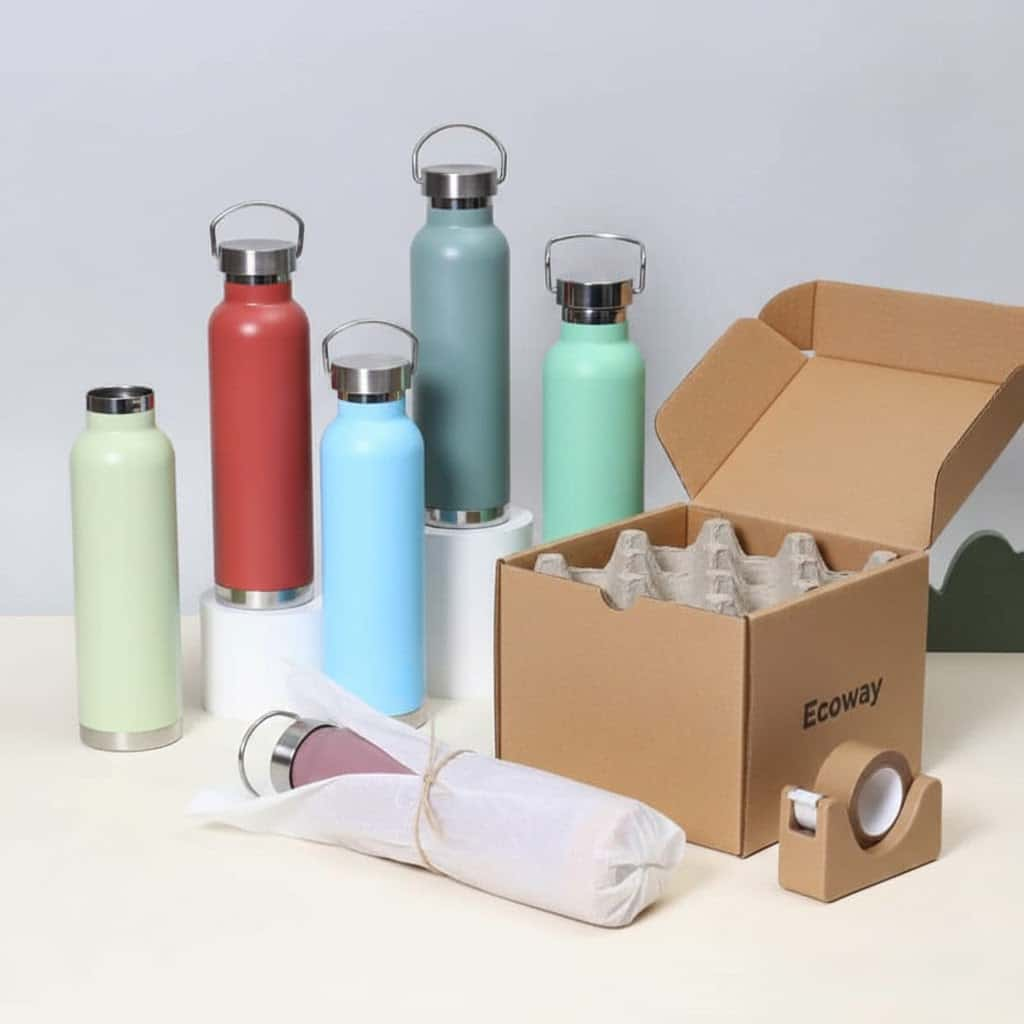

B2B Quick Answer: How Are Stainless Steel Water Bottles, Tumblers & Vacuum Flasks Made?
The stainless steel vacuum bottle manufacturing process is a high-tonnage, multi-step engineering operation. According to 2026 Ecoway industrial standards, producing premium 18/8 stainless steel insulated cups involves precise metal forming (Hydroforming or Deep Drawing), robotic laser welding for double-wall construction, high-temp vacuum insulation (10^-4 Pa), and rigorous thermal imaging QA testing.
9-Step Stainless Steel Tumbler & Cup Manufacturing Process
- Shell Forming: Shaping outer & inner bodies via Water Expansion or Deep Drawing (Seamless).
- Machining & Threading: Necking to exact size diameters and rolling threads for a leak-proof lid fit.
- Copper Lining: Applying a copper shield to the inner shell for Triple Vacuum Insulation.
- Assembly & Laser Welding: Fusing shells and bottom covers using automated robotic fiber lasers.
- Vacuum Brazing: Air extraction in a furnace using 100% Lead-Free Glass Frit Sealing.
- Internal Passivation: Electrolytic polishing to strip impurities, creating a chromium-rich anti-corrosion layer.
- Exterior Finishing: 200°C Powder Coating, PVD Plating, or 360° UV Printing for premium branding.
- Injection Molding: Synchronized molding of Tritan™ or PP lids and food-grade silicone gaskets.
- Final Thermal Testing: 100% automated temperature detection to ensure permanent vacuum integrity.
🎯 Sourcing Specialist Note:
Understanding the stainless steel thermos flask manufacturing process helps brand owners optimize BOM costs. Choosing Hydroforming (Stanley style) vs. Deep Drawing (Yeti style) directly impacts tooling budgets and silhouette complexity.

Forming Comparison: Yeti vs. Stanley
| Primary Tech | Target Style & Advantage |
|---|---|
| Hydroforming | Stanley/Owala Style: Complex ergonomic curves & car-cup bases. |
| Deep Drawing | YETI Style: 100% seamless rugged interior; handles thicker steel gauges. |
PHASE 1: MATERIAL SELECTION
Every premium product starts with the correct raw material. At our local fabrication facility, we source audited grades to match your brand's market positioning. All substrates are verified against our Master Material Standards & Compliance Hub.
- SUS 304 (18/8): The global industry standard for food-grade safety and reliable corrosion resistance.
- SUS 316 (18/10 Marine Grade): Elevated molybdenum content provides superior acid resistance. Ideal for high-end coffee and tea vessels.
- Pure Titanium (Grade 1): Our aerospace-grade metallic upgrade. 45% lighter than steel with zero metallic taste.
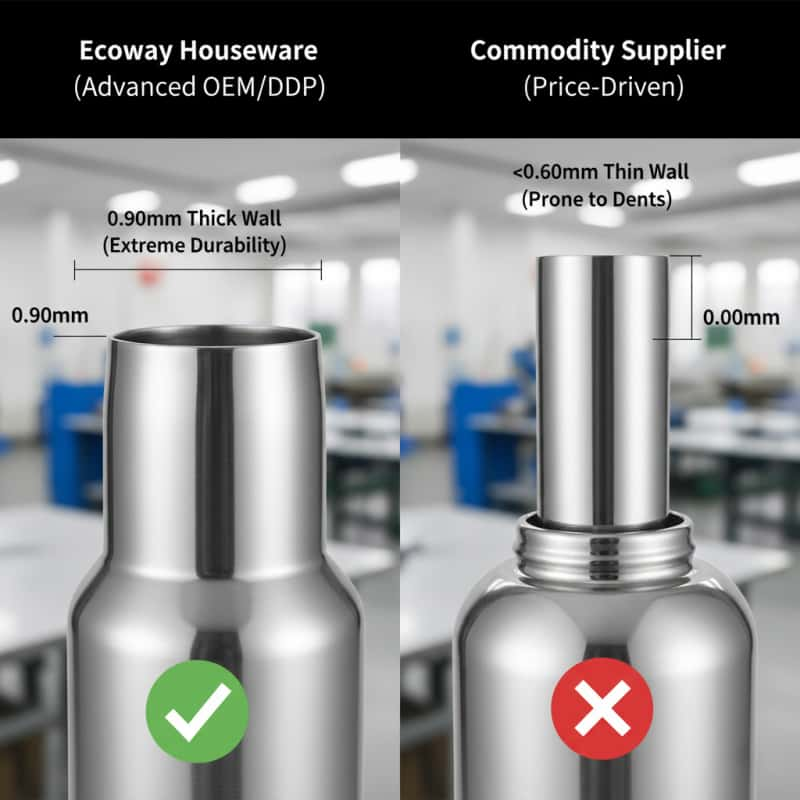
📏 Steel Gauge (Thickness) Specifications
| Commodity Standard | 0.40mm / 0.50mm |
| Tier-1 Brands | 0.60mm - 0.65mm |
| Ecoway Heavy-Duty Capability | 0.90mm - 1.00mm (Maximum dent resistance) |
PHASE 2: METAL FORMING, NECKING & THREADING
The core of the stainless steel thermos bottle manufacturing process involves transforming raw steel pipes and flat sheets into ergonomic silhouettes using high-tonnage precision machinery.
METHOD A: Deep Drawing (The "True Seamless" Process)
A flat stainless steel disc is subjected to multiple punching stages by a hydraulic press. This creates a 100% Seamless Interior, eliminating bacterial trap points—a standard requirement for Yeti-style rugged drinkware.

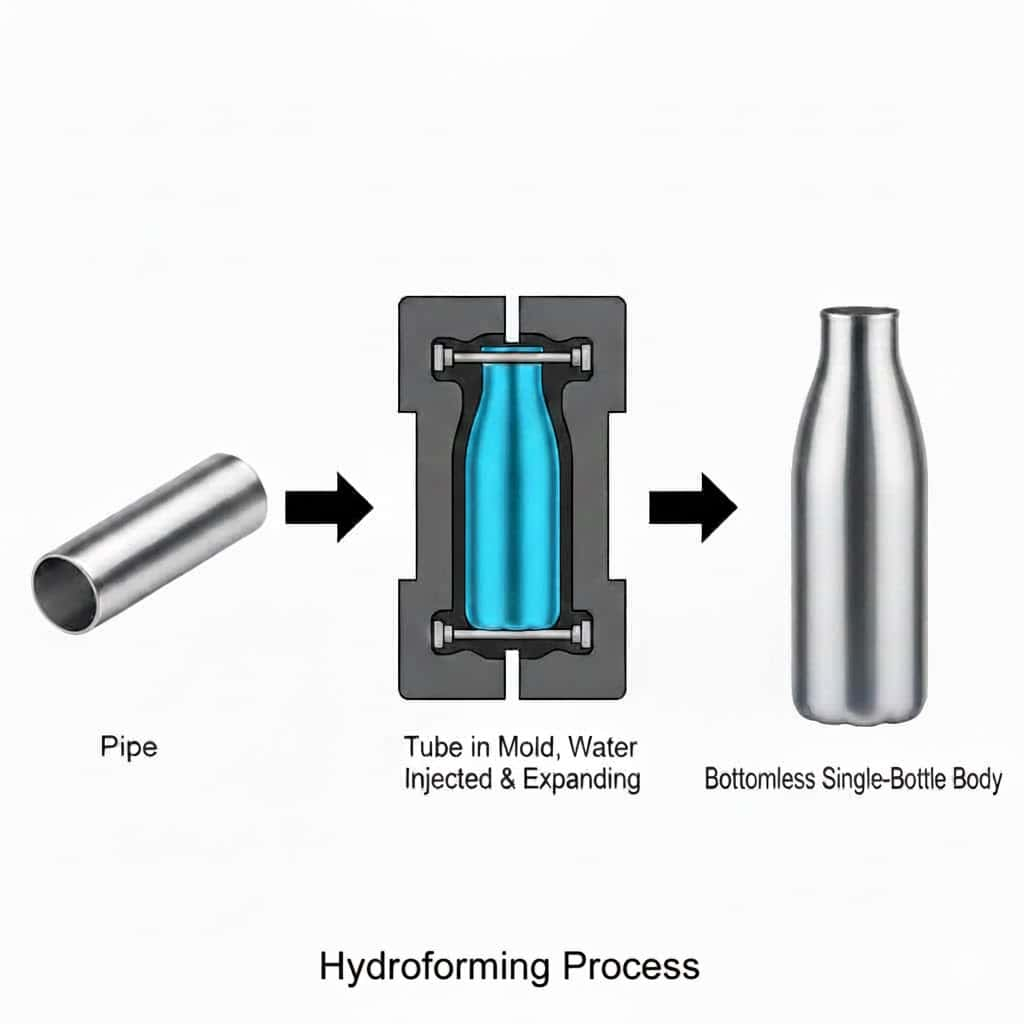
METHOD B: Tube Hydroforming (High-Pressure Expansion)
A welded steel pipe is placed in a hardened mold and expanded outward via high-pressure fluid. This allows for unmatched flexibility in creating complex curves and car-cup friendly tapered bases used in Stanley and Owala style bottles.
Precision Necking & Threading
After forming, the bottle mouth is squeezed to size (Necking) and precise screw threads are rolled. This ensures a 100% leak-proof fit with the lid, a critical failure point in commodity-grade products.
Factory Action: Forming & Manufacturing In Progress
⚙️ Industry Technology Matrix
| Criteria | Stanley Style | Yeti Style | Hydro Flask |
| Primary Tech | Tube Hydroforming | Deep Drawing | Lightweight Hydroforming |
| Design Priority | Complex Curves | 100% Seamless | Lightweight Portability |
| Steel Gauge | 0.5mm | 0.6mm-0.65mm | 0.4mm |
PHASE 3: THERMAL GAP INSULATION & LEAD-FREE SEALING
The thermal gap is the engine of the double-wall vessel, dictating its thermodynamic efficiency for the stainless steel vacuum flask manufacturing process.
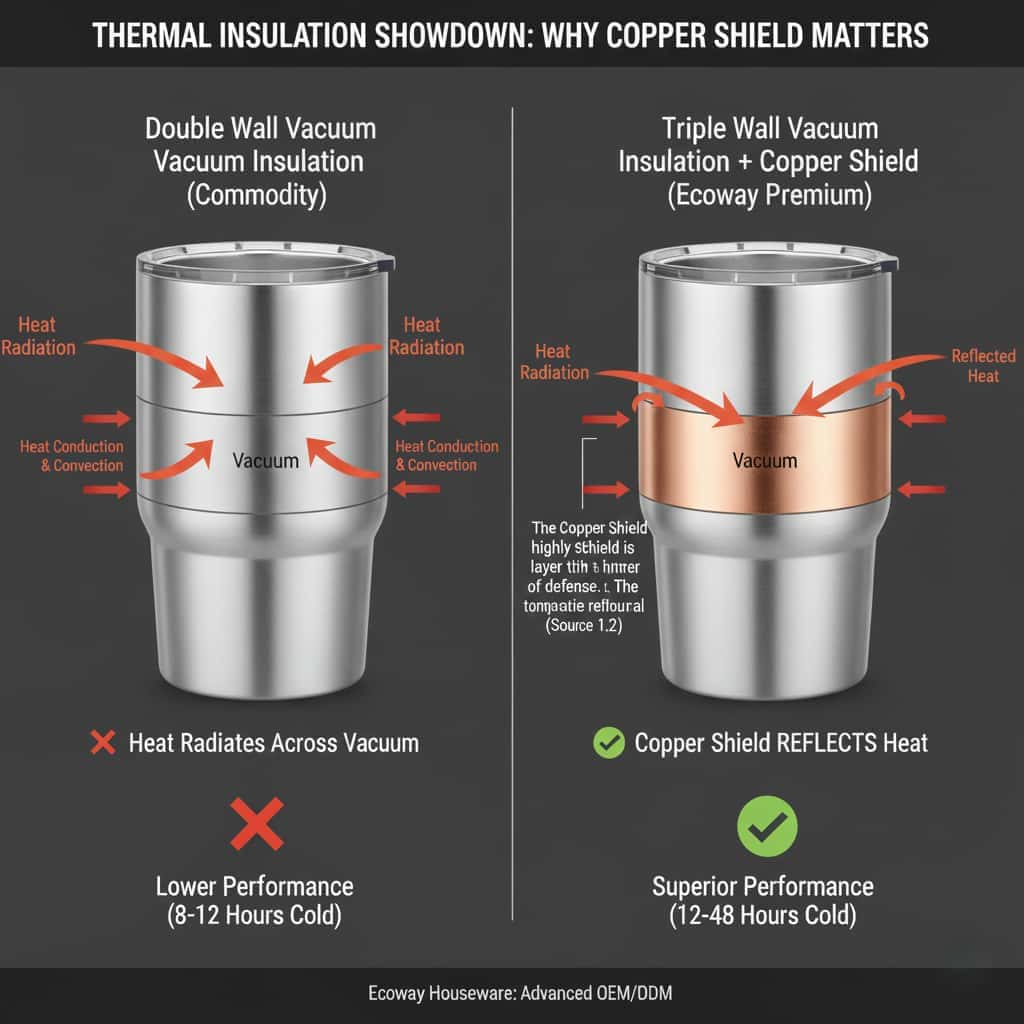
1. Thermal Radiation Shielding (Copper Plating)
Prior to assembly, the exterior of the inner shell is plated with copper. It acts as a mirror, reflecting thermal energy back into the liquid and lowering emissivity (ε).
ENGINEERING PRINCIPLE: THE STEFAN-BOLTZMANN LAW
The rate of heat transfer through radiation is minimized using high-temp vacuum brazing based on the formula:
Result: Our copper plating reduces heat loss by over 95% compared to standard non-plated vacuum vessels.
⚠️ Supply Chain Risk: Lead-Free Glass Frit Sealing
Unlike commodity competitors using cheap Lead (Pb) solder beads, Ecoway strictly utilizes high-temperature Glass Frit Sealing. This is the only path to ensure 100% compliance with California Prop 65 and FDA safety standards.
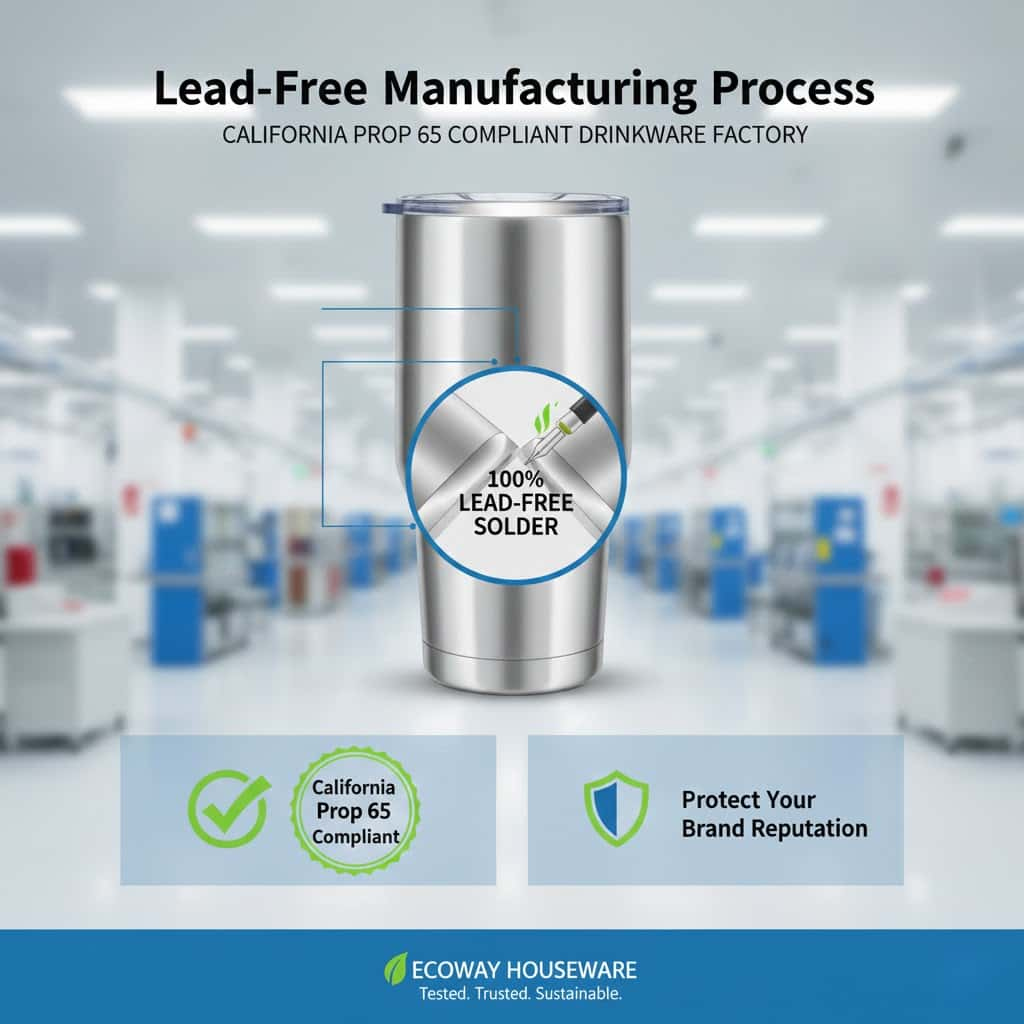
✅ In-Line QC: 100% Thermal Electromagnetic Testing
Every single unit undergoes automated temperature detection post-brazing to ensure lifetime vacuum integrity and a failure rate of less than 0.1%.
PHASE 4: INTERNAL PASSIVATION & CERAMIC LINING
Flavor purity and long-term corrosion resistance are determined by the internal treatment of the stainless steel cup manufacturing process.
Internal Electrolysis (Electrochemical Polishing)
The interior undergoes electrochemical polishing to strip iron impurities, leaving a chromium-rich passive layer. This medically clean surface prevents rust and ensures zero flavor carryover.

⚠️ Quality Control: Why do commodity cups rust?
Rust occurs when passivation is skipped to save costs. We validate every batch via ASTM B117 / ISO 9227 Salt Spray Testing to ensure a 100% rust-free finish.
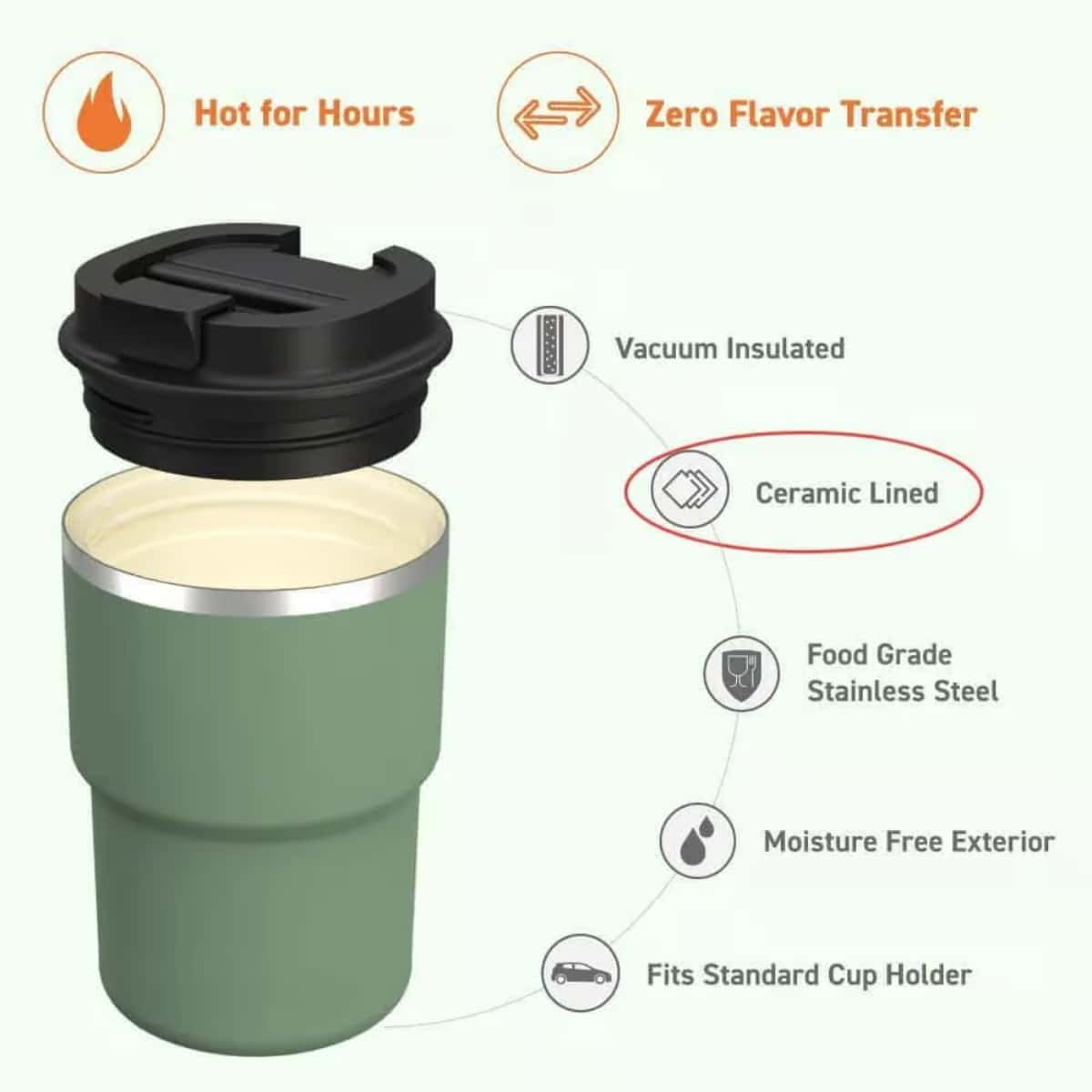
Advanced Internal Ceramic Coating (Metallic-Free)
For high-end coffee brands, we apply an optional Sol-Gel Ceramic Lining via spray-atomization. This prevents metallic ion transfer, preserving the peak flavor profile of specialty roasts.
PHASE 5: AESTHETIC FINISHING & BRANDING
This phase transforms the engineered core into a retail-ready asset. We apply advanced decorative layers and precision branding technologies to meet the diverse positioning of global retail brands. Explore all custom branding solutions.
| Exterior Finish | Performance Profile & Aesthetic Value |
| Polishing Finishing | The base process. Available in Mirror Polish (High-shine) or Satin/Matte Polish for a raw, professional steel aesthetic. |
| Spray Painting | Traditional liquid color application. Offers the widest range of high-gloss and vibrant Pantone matches for fashion-forward collections. |
| Powder Coating | High-temp cured (200°C). Provides a rugged, textured surface with extreme scratch resistance. The gold standard for outdoor drinkware. |
| Rubber Coating | Also known as "Soft-touch" coating. Provides a premium, non-slip velvety texture, enhancing user grip and perceived brand value. |
| PVD Coating | Physical Vapor Deposition. A high-tech metallic bonding process creating luxury finishes like Gold, Rose Gold, and Rainbow Titanium. |

Precision Branding & Logo Integration
To ensure your logo survives the lifetime of the product, we utilize synchronized branding equipment:
- Laser Engraving: Permanent, high-precision removal of the top coating to reveal the stainless steel beneath. Ideal for premium, understated branding.
- Silk-screen Printing: Cost-effective high-volume solution for 1-2 color logos with excellent color accuracy and opacity.
- 3D UV Printing: The ultimate in customization. Supports unlimited colors, gradients, and tactile embossed textures with photographic resolution.
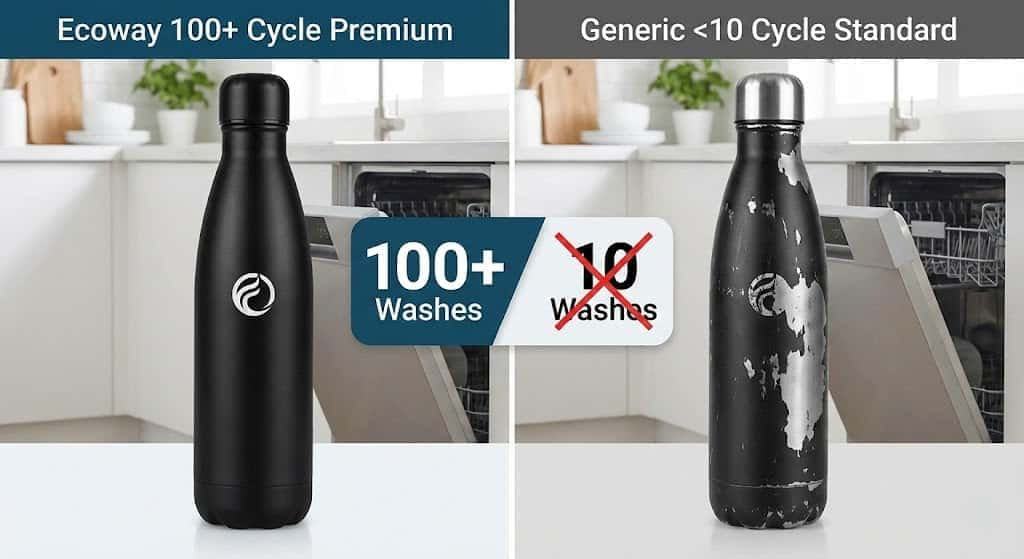
TESTING STANDARD: The "100-Cycle" Dishwasher Safe Test
Our exterior powder and paint formulations are engineered to withstand over 100 high-temperature, caustic detergent wash cycles without delamination, fading, or peeling. This ensures your brand assets remain pristine in both home and commercial environments.
PHASE 6: COMPONENT INJECTION MOLDING
A hydration flask is only as reliable as its lid. To ensure a 100% leak-proof seal and smooth torque, we operate synchronized injection and compression molding for all accessories at our fabrication center. This high-precision approach guarantees perfect thread matching and gasket seating, eliminating the "wobbly lid" issue common in generic wholesale products.
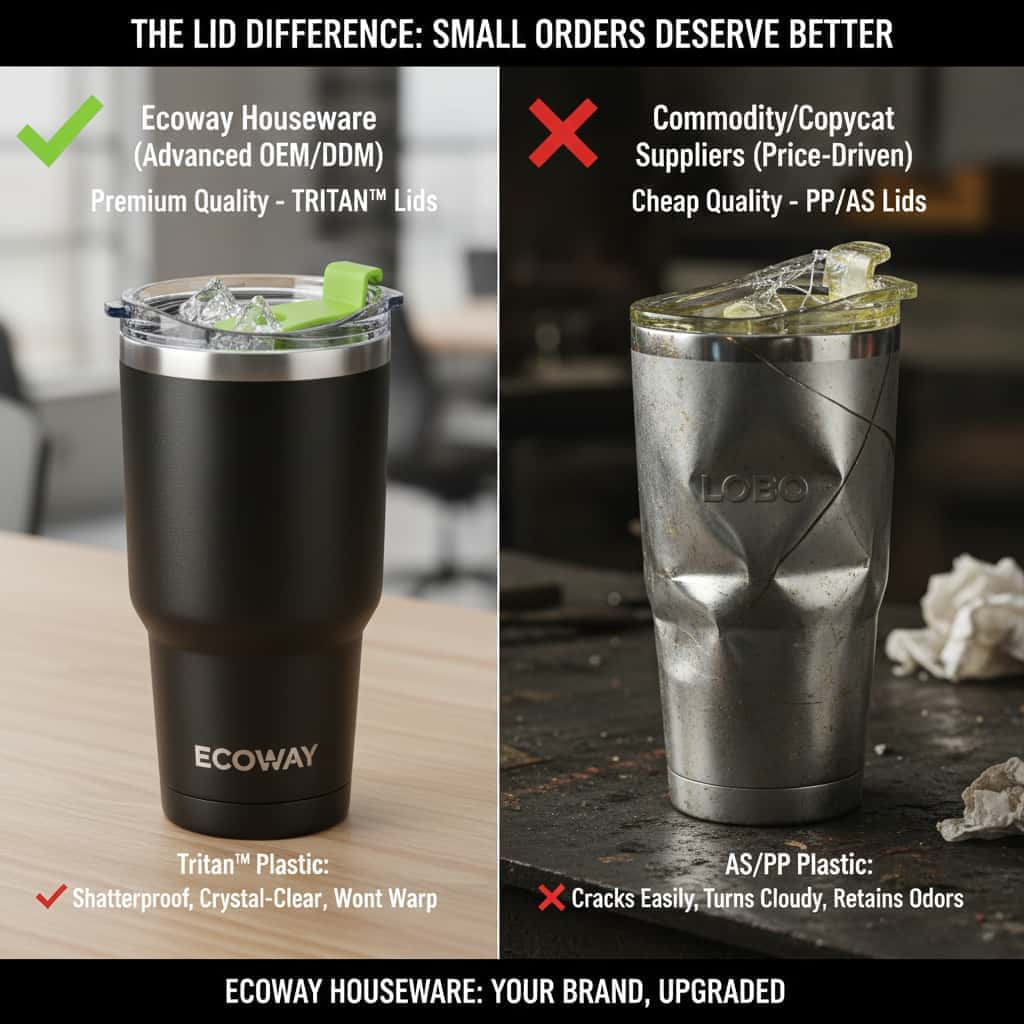
BPA-Free Polymers: Tritan™ vs. Commodity Plastics
For clear lids and straw components, we standardize the use of Eastman Tritan™ Copolyester. While cheaper facilities use AS or PS plastics that rapidly yellow, retain odors, and shatter upon impact, Tritan™ remains crystal clear and virtually indestructible, even after repeated commercial dishwashing cycles.
Advanced Overmolding Technology
We utilize dual-injection overmolding to fuse soft-touch TPE grips directly onto rigid PP lid structures. This eliminates the need for glues, ensuring the components never separate and remain 100% food-safe and hygienic.
PHASE 7: FINAL ASSEMBLY, QA & DDP LOGISTICS
The final stages of the stainless steel insulated cup manufacturing process focus on rigorous quality control validation and specialized retail-ready assembly to ensure global brand consistency.
Industrial Quality Control & Thermal Validation
Before containerization, 100% of our products undergo a multi-stage inspection protocol to prevent vacuum failure in the market:
- Leak Detection Test: Every unit is subjected to pressure testing to verify the structural integrity of the automated robotic laser welding between the inner and outer bodies.
- Thermal Detection (Hot Air Test): All batches pass through an automated infrared temperature detection tunnel. Any vessel exhibiting exterior heat conduction is instantly rejected to ensure lifetime vacuum performance.
- Final AQL Inspection: Conducted to MIL-STD-105E standards to verify thread engagement torque, surface finishing consistency (Delta E color matching), and packaging integrity.
Precision Assembly & Component Molding
A hydration flask is only as reliable as its lid. We utilize synchronized dual-injection overmolding for complex accessories, standardizing BPA-Free Eastman Tritan™ Copolyester for clear components. This ensures lids are shatter-resistant, remain crystal clear, and provide a 100% leak-proof seal with food-grade silicone gaskets.
🌿 Sustainable Packaging & Global DDP Logistics
Ecoway provides 100% plastic-free fulfillment options using FSC-certified honeycomb paper sleeves. All master cartons are engineered and tested to pass ISTA 1A Drop Tests, ensuring zero damage during long-haul transit.
B2B Logistics Advantage: We manage full DDP Shipping solutions for USA, EU, UK, and Australian markets, handling all customs clearance and prepayment of import duties to facilitate a seamless door-to-door delivery to your warehouse.