
Stainless Steel Water Bottles Compared: Single-Wall, Air-Insulated, vs. Vacuum-Insulated Drinkware

Engineering comparison of single wall, air insulated, and vacuum insulated bottle architectures

When evaluating stainless steel drinkware structures for B2B wholesale and OEM brand scaling, the market divides into four distinct architectural tiers: Single-Wall (ultralight utility and open campfire heating), Double-Wall Non-Vacuum / Air-Insulated (desk-bound thermal buffers like commercial bowls and coffee cups such as Returnr or Yeti-style bowls), Double-Wall Vacuum Insulated (the 24H+ retail standard seen in Stanley, Owala, and Hydro Flask), and advanced engineering tiers like Triple-Wall Copper Shielding and 1.00mm Thicker-Steel™ (such as the custom thermal housings produced for Cirkul). Choosing the correct structure dictates gross margins, risk profile, and B2B profitability.

Executive Sourcing Briefing

For B2B brand owners and procurement teams, selecting the right stainless steel bottle structure dictates your profit margins and target market. Sourced directly from certified factories with 1,000-piece MOQ thresholds, the industry spans from high-volume ultralight single-wall vessels to premium vacuum-insulated masterpieces.

  • 🔥 Single-Wall Zero insulation. Sweats with ice. Lowest EXW cost ($2.10–$2.80). Ideal for ultralight camping & massive promos.
  • ❄️ Vacuum Insulated 10⁻⁴ Pa vacuum + Copper lining. 100% sweat-free. Highest ROI and target MSRP ($35+).
  • 🛡️ The Compliance Regardless of structure, ensure FDA/LFGB compliance and Lead-Free sealing for global retail.
Table of Contents

The Scientific Limitation: Convection Heat Transfer

Because air molecules remain present in the structural gap, heat is continuously transferred through convection. Hot liquid heats the inner wall, which vibrates the trapped air molecules, eventually transferring that kinetic energy to the outer wall. To understand the granular physics of heat migration in steel drinkware, explore our core physical breakdown: What is a Thermos? The Science of Heat Retention.

  • Structural Benefit (Ergonomics): The primary commercial use case for air insulation is safety. It prevents the exterior from becoming too hot to hold, essentially functioning as a permanent, rigid "sleeve" for hot beverages.
  • Commercial Application: This structure is prevalent in specific "desk-bound" form factors, such as the commercial double-wall coffee cups (e.g., Returnr's reusable cup system) or double-wall stainless steel bowls (like the Yeti dog bowl series).
  • Sourcing Logic & Capping: Procurement managers deploy air-insulated structures when of temperature stability is sufficient, and the BOM budget cannot accommodate the expensive 570°C vacuum brazing furnace process required for true vacuum vessels.
B2B Risk Matrix: If a consumer expects "Stanley-level" ice retention from a double-wall air-insulated product, the resulting 1-star reviews will destroy your Amazon listing. Transparency in marketing is critical. Never label an air-insulated product as "Vacuum Insulated."

The Engineering Leap: Copper Radiation Shielding & Thicker Walls

While a standard 10⁻⁴ Pa vacuum stops conduction, heat can still slowly escape via Infrared Radiation. Premium factory standards mandate an internal 0.02mm copper coating applied to the vacuum-facing side of the inner wall. This copper layer acts as an infrared mirror, reflecting radiant heat back into the beverage.

Beyond the Standard: To surpass legacy competitors, Ecoway deploys advanced architectures. We integrate Triple-Wall Vacuum Insulation with Copper Shielding for extreme thermal locking. Furthermore, for brands seeking unparalleled durability and an additional 10%+ thermal boost (similar to the OEM parameters we utilize for Cirkul's hydration systems), we upgrade the exterior shell to 1.00mm Thicker-Steel™, preventing dents that compromise the vacuum seal.

stainless steel water bottles compared insulated vs vacuum insulated vs single wall non insulated

Engineering POV: Production Process Complexity

For a Product Developer navigating an OEM/JDM roadmap, the manufacturing complexity of the chosen structure dictates lead times (typically 165 days for a new custom mold) and QA risk profiles. True vacuum insulation requires fundamentally different metallurgy and precision than simple single-wall stamping.

Manufacturing Process Single-Wall Double-Wall (Air) Ecoway True Vacuum (Premium)
Forming & Shaping Basic Stamping / Stretching Dual Component Sizing Hydro-forming & Precision Deep Draw
Welding Infrastructure Mouth Seam only Internal & External Seams Argon Arc + Laser Seam Integration (Denting Prevention)
Core Thermal Treatment N/A Mechanical Gasket Sealing 570°C Vacuum Brazing Furnace ( Cycle)
Quality Control (QA) Visual & Dimensional Air Leakage Test 100% Infrared Thermal Scanning (Twice)

Supply Chain Logistics Note: Higher manufacturing complexity extends the production timeline. Vacuum insulated bottles require a mandatory stabilization period between the high-temp vacuum furnace and exterior coating (e.g., 200°C powder coating) to identify micro-leaks.

Strategic Metric (32oz Volume) Single-Wall Double-Wall (Air) True Vacuum (Premium)
Est. Factory BOM (EXW) $2.10 – $2.80 $3.20 – $4.10 $4.50 – $6.50
Target Retail MSRP $12.00 – $18.00 $18.00 – $25.00 $35.00 – $55.00
Brand ROI Potential Moderate (Volume Driven) Stable (Niche Utility) 🚀 Maximum (85%+ Gross Margin)

💡 Commercial Insight for Procurement: While genuine vacuum insulation commands a higher EXW unit cost (e.g., $5.20 vs $2.80), it enables a retail price tag that is often 200% to 300% higher. This "Premium Gap" is where your marketing budget and brand equity are built. For a complete breakdown of landed costs including Section 301 tariffs, consult our Manufacturing Cost Guide.

US Market (FDA & Prop 65)

Mandates strict adherence to FDA 21 CFR standards. For vacuum models, the critical risk is heavy metal exposure. Ecoway mitigates this entirely via our 570°C Lead-Free sealing process, ensuring absolute California Prop 65 immunity.

EU Market (LFGB)

Requires aggressive migration testing limits for Chromium and Nickel. We guarantee compliance by sourcing only virgin SUS304/SUS316L (PREN > 19.0). For a deep dive into global chemical regulations, reference our FDA/LFGB/Prop 65 Compliance Hub.

Launch Your Custom Drinkware Structure

From single-wall ultralight models to Cirkul-grade 1.00mm Thicker-Steel™ vacuum housings. Lock in your OEM timeline today.

*Mold fees ($2.5k–$32.5k) are 100% refunded upon reaching 500,000 units. Secure your IP with our 10-Year NNN Agreement.

7. B2B Sourcing FAQ: Drinkware Structures

Why choose vacuum insulated over double-wall air insulated?

Double-wall air insulated bottles rely on trapped air to buffer temperature, lasting only before convection forces equilibrium. Genuine vacuum insulation removes air molecules completely (reaching 10⁻⁴ Pa), shutting down convection and conduction. This keeps beverages cold for and creates a 100% sweat-free exterior critical for premium retail margins.

Are single-wall stainless steel bottles safe for hot coffee?

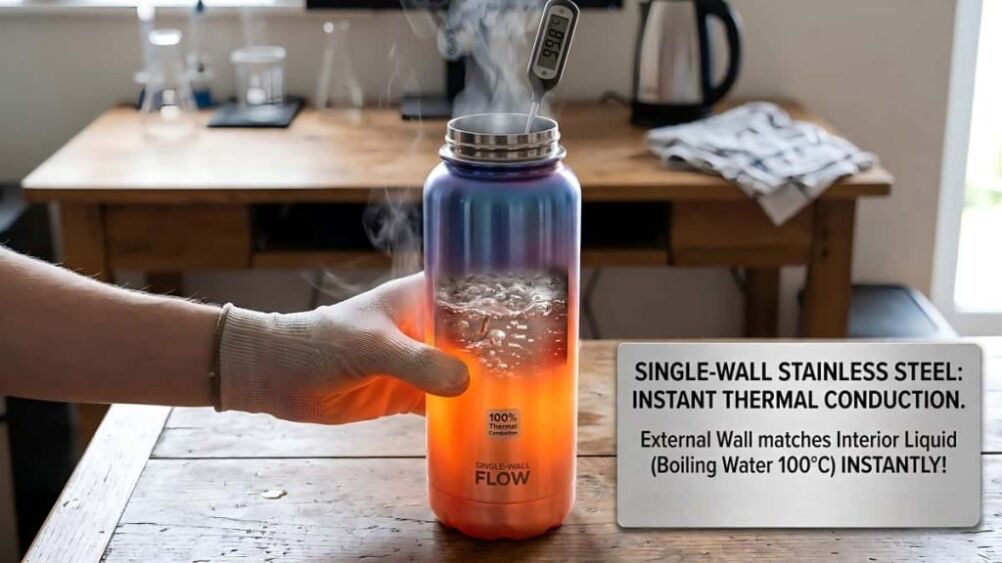
No. Single-wall virgin SUS304 steel is an excellent thermal conductor. Without an external silicone or cardboard sleeve, the exterior wall will reach the internal liquid's temperature within seconds, creating a severe burn risk and liability for your brand. For hot beverages, you must source double-wall vacuum insulated coffee mugs.

What is the BOM cost difference between single-wall and vacuum structures?

A standard 32oz single-wall bottle has a factory EXW cost of roughly $2.10–$2.80. The vacuum-insulated equivalent demands over 12 additional complex manufacturing steps (including copper plating and 570°C vacuum brazing), bringing the EXW cost to $4.50–$6.50. However, the vacuum model allows brands to command a 200%+ higher retail MSRP.

What is the MOQ, and how does the mold fee refund work for custom structures?

For existing structural geometries with custom colors, the MOQ is 1,000 units. For entirely new structural designs (OEM tooling), the MOQ is 3,000 units. New mold fees range from $2,500 (stamping) to $32,500 (complex injection molding), but Ecoway refunds 100% of the mold fee once cumulative purchase volume reaches 500,000 units.

How do you protect proprietary vacuum and structural designs?

We treat brand IP with military-grade confidentiality. Before any DFM or CAD files are shared regarding new wall thicknesses or structures, we sign a legally binding 10-Year NNN (Non-Disclosure, Non-Use, Non-Circumvention) Agreement enforceable in both Hong Kong and Mainland China jurisdictions.

Van Huang - Head of Marketing and JDM Engineering at Ecoway Houseware
Van Huang Head of Marketing and JDM Engineering Structural Engineering Verified

Operating directly from the Yongkang Nasheng Industrial facility, Van Huang connects retail brand goals with physical manufacturing realities. His expertise in 10⁻⁴ Pa vacuum thermodynamics, 0.90mm thick-steel fabrication (as utilized in custom Cirkul projects), and 570°C lead-free brazing processes ensures every structural decision maximizes B2B profit margins while eliminating compliance risks.

Technical Expertise: Vacuum Furnace Thermodynamics (10⁻⁴ Pa), Cirkul-Grade 1.00mm Thicker-Steel™ Engineering, 570°C Lead-Free Brazing, Returnr-Style Double-Wall Air Structures, OEM Supply Chain Cost Analysis.

*Physical Limitations Disclosure: The thermal performance data presented herein assumes optimal ambient conditions (20°C - 25°C). While true vacuum structures halt conduction and convection, performance relies heavily on the design of the lid (e.g., Tritan™ vs. insulated steel plugs). Furthermore, single-wall structures possess zero thermal retention and pose immediate burn hazards if filled with boiling liquids. Ensure your packaging explicitly states these warnings to mitigate brand liability.

Drinkware Technical Sourcing Hub

Understanding structural architectures—from single-wall utility to triple-wall vacuum—is the foundation of brand scaling. Deepen your OEM intelligence with our core manufacturing guides.

Scroll to Top