
The JDM Smart Hydration Framework: Rigorous NDA and NNN IP Protection Guardrails
In the highly competitive global consumer tech and wellness landscapes across North America, Europe, the UK, APAC, and Australasia, launching a breakthrough product requires absolute security. For global brand owners and enterprise product managers seeking to develop next-generation smart drinkware, the deployment of a structured JDM framework is critical. At Ecoway Houseware Limited, this high-precision engineering lifecycle balances advanced hardware integration with airtight proprietary asset management.
Legal Infrastructure: Securing Cross-Border Technology Transfers
Before a single 3D CAD mesh is rendered or circuit board trace is drawn, establishing legal sovereignty over proprietary firmware code and custom mechanical aesthetics is mandatory. Standard international non-disclosure agreements frequently fail to prevent unauthorized tool replication inside overseas manufacturing hubs. To mitigate this risk for tier-one brands in the US, Eurozone, and emerging markets, Ecoway mandates the execution of a jurisdiction-specific NNN agreement linked to regional enforcement courts.
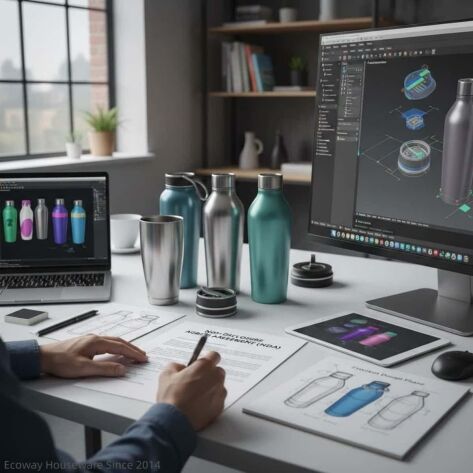
This initial legal framework forms the unshakeable foundation for integrating complex IPX7 IoT smart lids, custom app-syncing wireless modules, and advanced 0.05mm ultra-lightweight CNC metal spinning technologies. By formalizing intellectual property boundaries during the pre-engineering contract phase, global procurement teams safely initiate complex hardware development loops, eliminating the legal friction common to standard open-market sourcing channels.
2. Industrial Concept Design: Harmonizing IoT PCB Form Factors and Mechanical Ergonomics
Once the legal perimeter is fully secured, the engineering matrix transitions into the critical phase of industrial concept design. For global consumer electronics brands and high-end outdoor labels, designing a smart hydration vessel requires a complex harmonization between traditional industrial metallurgy and electrical hardware placement. Sourcing teams frequently encounter catastrophic failure loops when trying to force off-the-shelf electronics into standard bottle formats.
The DFM Alignment: Space Allocation for Smart Assemblies
At this juncture, Ecoway’s JDM engineering desk initiates a thorough Design for Manufacturing (DFM) audit. Every concept sketch balances the aesthetic demands of Western and Asian retail markets with rigid structural constraints. We map out the volumetric requirements for the OLED digital display screen, the lithium-ion battery cell pack, and the wireless communication layout while preserving a standard 58mm universal wide-mouth diameter chassis profile.

Our design philosophy prevents the two most common failures in smart drinkware: restricted thermal boundaries and component overcrowding. By using advanced software modeling, we establish a fixed 2mm to 4mm vacuum boundary layer clearance, protecting the delicate internal FDA-grade NTC thermal sensors and circuit board arrays from external physical stress. This careful balancing phase ensures the product delivers excellent thermal retention alongside stable computing performance.
3. Prototype Sample Manufacturing: High-Fidelity 3D Printing and Physical Structural Evaluation
With the optimized blueprints locked, the JDM workflow advances to prototype sample manufacturing. This phase serves as the critical validation checkpoint where digital concepts are translated into physical matter. To bypass the extreme overhead of cutting steel molds prematurely, Ecoway deploys advanced additive manufacturing, using high-precision SLA and SLS 3D printing technologies to fabricate high-fidelity engineering mockups and functional hand-samples.
Form-Factor Assessment: Testing Spatial Stack-Ups and IoT Ergonomics
These physical mockups are critical for assessing both cosmetic ergonomics and mechanical assembly clearings. During this step, our lab engineers fit preliminary BLE 5.3 IoT hardware modules, lithium-ion battery cells, and FDA-grade NTC thermal sensor arrays directly into the 3D-printed lid and chassis shells. This spatial tracking verifies snap-fit compliance, ensures optimal antenna signal window propagation, and guarantees that the computing modules integrate into the physical boundaries with zero structural interference.

The data gathered from these real-world functional evaluations provides immediate feedback for the final refinement of our production blueprints. By analyzing thread friction, component tolerance stack-ups, and handheld balance on the 3D prototypes, we safely isolate and resolve hidden clearance errors. This systematic curing loop finalizes the master 3D CAD coordinates right before entering the capital-intensive tooling development phase, protecting brand owners from costly post-mold modifications.
4. Tooling Development: Advanced Metallurgical Dies and the 500,000-Unit Amortization Balance
Upon verification of the functional prototype, the supply chain matrix transitions into hard tooling development. For global B2B procurement directors and venture-backed drinkware hardware brands, this stage represents the largest upfront capital allocation. Professional manufacturing demands the engineering of heavy-duty hydraulic expansion dies for the steel chassis alongside multi-cavity high-precision injection molds to form the complex modular closure systems.
Capital Optimization: Tooling Amortization and Risk Mitigation
To alleviate financial friction for premium brands expanding into smart drinkware, Ecoway deploys a structured tooling capitalization framework. We establish a clear milestone ledger bound to the 500,000-unit full tooling fee refund break-even threshold. By factoring this amortized offset directly into the JDM framework, enterprise buyers protect their initial cash reserves while securing dedicated industrial mold priority on our active Jinhua-Yongkang production loops.

Operational tooling execution is strictly governed to eliminate micro-capillary leakage inside the final hardware. Our engineering lines cut the internal neck thread steel cores under an unyielding ±0.05mm dynamic tooling precision tolerance standard. This rigorous dimensional throttling ensures that the final molded 58mm universal wide-mouth diameter chassis seamlessly accepts high-durometer silicone gaskets and robotic sub-assemblies, providing an airtight environment that preserves the long-term 10⁻⁴ Pa high-vacuum state.
5. Trial-Run Production, Mass Manufacturing, and Multi-Modal Global Delivery Fulfillment
Following the engineering completion of hard tooling matrices, the JDM lifecycle moves into the critical phase of trial-run production. This phase serves as the dynamic bridge between development and heavy industrial replication. Before scaling up to full capacity, we run an initial batch under strict AQL 2.5 quality control protocols to stress-test the alignment of the newly processed machinery, ensuring the hardware components integrate flawlessly on active conveyor loops.
Industrial Reliability Curing: Stress-Testing the Smart Vessel Chassis
During this pilot validation window, the hardware units undergo comprehensive destructive testing inside our verification laboratories. Lids and integrated PCB sub-assemblies endure severe thermal shock and continuous IPX7 waterproof testing to ensure zero water ingress. Concurrently, the surface textures are evaluated under ASTM D3359 Grade 5B adhesion metrics and ASTM B117 salt spray environments to guarantee premium dishwasher endurance, while electronic computing units are continuously cycled to verify firmware and NTC sensor calibration.
Once the trial-run verification yields zero mechanical anomalies, Ecoway releases the framework into the official mass production phase. Our facilities initialize large-scale assembly lines backed by a standard commercial MOQ 3,000 Pcs platform setup. During this final phase, the dual-wall cores enter massive continuous vacuum brazing furnace networks where automated sensors monitor the execution of the 570°C lead-free glass frit sealing protocol, permanently locking in the long-term 10⁻⁴ Pa high-vacuum state across every single vessel.

The final operational gatekeeper is pre-shipment quality auditing. Every container lot undergoes high-velocity visual inspections to ensure a strict color profile match holding a Delta-E color variance limit < 1.0. Following package wrapping, global logistics dispatching supports flexible multi-modal shipping frameworks tailored to localized target margins:
Provides base factory or port rail commodity handovers, giving established brands full control over their destination freight forwarders and transport networks.
Ecoway manages total border custom clearances and tariff filing risks, fully buffering retail profit margins against volatile Section 301 Trade Actions.
Freight is explicitly routed under international 6-digit harmonization standards, mapping directly to HS 9617.00 and 7323.93 for frictionless entry.
By establishing complete vertical integration from early legal NDA protection and 3D CAD drawing adjustments through hard tool development, trial batch validation, and mass shipping fulfillment, Ecoway provides a seamless, zero-liability manufacturing pipeline. This structural roadmap allows premium global hydration brands to scale their advanced IoT electronics and lightweighted steel concepts safely from initial engineering drafts into top-tier retail execution.
6. Strategic R&D Synthesis: Overcoming Smart Hydration Barriers and Weight Constraints
The commercial expansion of advanced smart drinkware relies entirely on a brand's ability to balance technical feature sets with lightweight field performance. For global enterprise clients sourcing from specialized hubs, achieving a sustainable market presence requires a manufacturing pipeline that successfully merges electronics integration with precise structural execution. At Ecoway Houseware, our dedicated research desks eliminate early hardware failures, allowing partners to scale complex concepts safely.
Core Technical Convergence Matrix
By looking past basic open-market designs, our engineering loops actively solve the issues of short product lifetimes and water ingress. We replace standard assemblies with robust mechanical and computing configurations:
We completely encapsulate displays and circuitry using professional ultrasonic welding and epoxy potting, securing an IPX7 waterproof rating. Custom computing arrays deploy energy-efficient BLE 5.3 chips to deliver up to 90 days of battery life, syncing natively with premium health applications.
Internal tracking utilizes sensitive FDA-grade NTC thermal sensors wrapped inside protective SUS316 steel sleeves to secure a strict ±1°C tracking accuracy, keeping consumer safety secure while preventing chemical leaching across extreme temperatures.
Physics of Mass Optimization Bounds
Traditional manufacturing methods are limited to standard thinning thresholds that leave excess dead weight in the container walls. Our manufacturing setups use precise secondary processes to selectively thin specific zones of the steel container, achieving massive weight savings for demanding commuter markets:
* Technical Note: Reducing wall thickness to this extreme range serves a single structural objective—eliminating empty weight without sacrificing the 10⁻⁴ Pa high-vacuum state or compromising the integrity of our 570°C lead-free glass frit sealing protocol.
7. R&D Engineering FAQ: Smart Hardware & Lightweight Spinning
Are temperature display smart lids safe to wash or put in the dishwasher?
What is the battery life of a smart hydration tracking water bottle?
How thin can stainless steel be spun for lightweight water bottles?
8. Strategic Material Sourcing & Intelligence Network
Browse our verified knowledge base assets and specialized manufacturer networks to guide your next commercial drinkware procurement project:
9. Initialize Your JDM Smart Hydration Project: Request a Technical DFM Audit
Accelerate your product development roadmap while protecting your bottom line. Contact our Yongkang engineering desk today to execute custom NDA/NNN agreements, review your hardware schematics, and align your product specifications with our 500,000-unit tooling amortization framework.
