
2025-2031 Global Drinkware Market Forecast: Strategic B2B Sourcing Intelligence for Brand Owners

2026-2031 Global Drinkware Market Forecast - Premium 40oz OEM ODM solutions and supply chain intelligence

Executive Verdict: - Drinkware Market Sourcing Strategy

The - global drinkware market forecast indicates a definitive pivot from commodity hydration to high-margin, ESG-compliant lifestyle vessels. To defend retail margins and mitigate supply chain risks, B2B brand owners must transition to four strategic pillars: leveraging RCS-certified recycled stainless steel to bypass EU CBAM penalties, capitalizing on the 40oz+ hydration heavyweight trend, integrating internal ceramic coatings to eliminate metallic taste, and bypassing trading companies for direct OEM partnerships. By structuring agreements with verified source factories, supply chain directors can secure massive 40oz handle tumbler BOM costs between $5.20 and $6.50, achieve a rapid 165-day OEM deployment cycle, and unlock 100% mold fee refunds upon reaching 500,000 units—ultimately driving gross retail margins above 85%.

Table of Contents

1 The ESG Super-Cycle: Bypassing EU CBAM Penalties

Moving into , consumer preference for "green" products has hardened into stringent international trade laws. Regulatory bodies in North America and Europe are actively enforcing Extended Producer Responsibility (EPR) frameworks and the impending EU Carbon Border Adjustment Mechanism (CBAM). Relying on undocumented materials or generic plastics will now result in severe customs friction and brand-destroying greenwashing lawsuits.

Securing your global supply chain requires pivoting exclusively to virgin SUS304 (PREN 19.0) or SUS316L (PREN 24.5) with verified RCS (Recycled Claim Standard) certifications. Furthermore, to mitigate California Proposition 65 recall risks and block heavy metal leaching (like lead from cheap sealing frits), brand directors must establish a strict FDA, LFGB, and Prop 65 compliance architecture at the factory level.

⚠️ Structural Material Shift

If your product lines—such as high-end gym shakers or fruit infusers—demand optical clarity where steel cannot be deployed, obsolete standard plastics must be phased out immediately. B2B buyers must migrate to shatterproof, BPA-free copolyesters by evaluating Tritan™ TX1001 vs. PP vs. AS lid and body material benchmarks to ensure high-temperature dishwasher safety without structural degradation.

2 Hydration Heavyweights: The 40oz+ Commuter Paradigm

The "Post-Stanley" market is not retreating; it is hyper-segmenting. The demand for massive, all-day hydration vessels has evolved into the "Quiet Utility" aesthetic, characterized by tapered bases and hybrid 2-in-1 sip-and-swig lids. Before committing to injection molds, establishing a data-driven capacity and sizing strategy tailored to specific demographic hydration goals is crucial for maximizing inventory turnover.

The absolute pinnacle of this growth trajectory is the 64oz cup-holder friendly stainless steel tumbler with an ergonomic handle. However, scaling a vessel to 64oz introduces a severe thermodynamic vulnerability: massive heat transfer surface area. To prevent ice from melting within hours and tanking your Amazon reviews, the manufacturing process must deploy extreme vacuum thresholds (up to 10^-4 Pa) paired with a 0.02mm pure copper radiation shield to guarantee true + cold retention.

3 CMF Evolution: Eradicating Metallic Taste & Driving Margin

In the fiercely competitive retail landscape, standard matte powder coating is no longer a differentiator—it is a baseline. Brands are actively losing high-LTV specialty coffee and wellness demographics due to flavor contamination. Understanding the hidden OEM manufacturing flaws that cause stainless steel to rust or retain metallic odors is the first step in defending your seller rating.

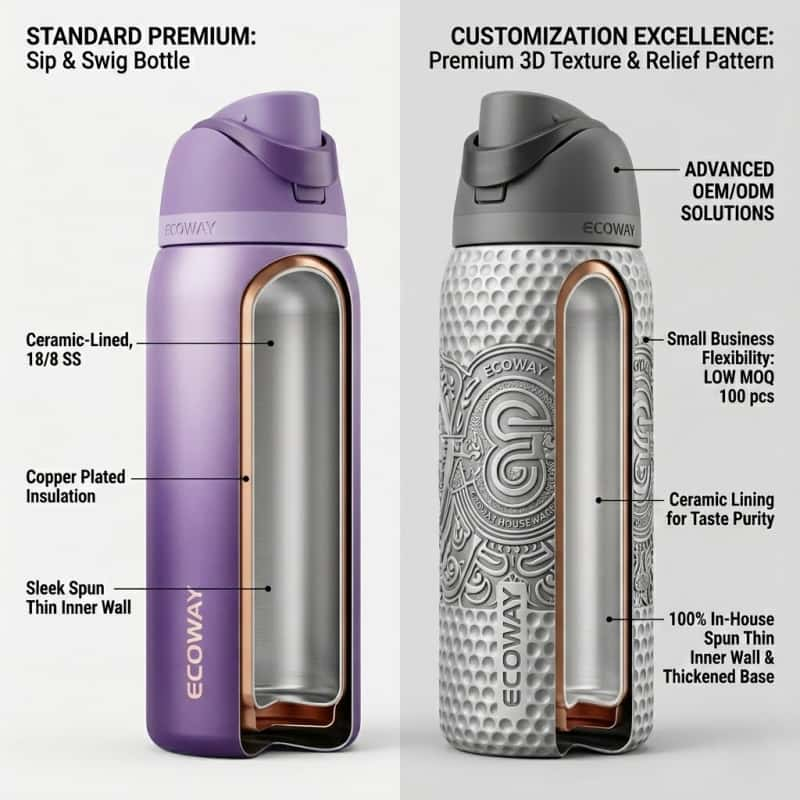
The ultimate strategic countermeasure is CMF premiumization. Upgrading your vessel's interior by integrating Sol-Gel internal ceramic coating technology fundamentally transforms the product. It creates a stain-resistant, zero-flavor-transfer barrier that aligns perfectly with luxury hydration branding.

📈 The Commercial ROI Multiplication

When utilizing a direct-to-factory OEM partnership, bypassing the 20%-30% middleman markup is just the beginning. While adding a 3D tactile finish or a ceramic liner might marginally increase your base unit BOM manufacturing cost by $1.00 to $2.00, it dramatically alters the perceived value, allowing brand owners to safely elevate the Retail MSRP by $15.00 to $20.00.

Strategic Sourcing Matrix: Trading Company vs. Direct OEM

Navigating global freight volatility and ESG compliance mandates requires direct access to R&D foundries. Bypassing middlemen not only captures a 20%+ margin delta but also secures engineering transparency.

Critical Dimension Standard Trading Company Ecoway Direct OEM Foundry
Supply Chain Footprint Blind Sourcing (High risk of unauthorized sub-contracting) Vertically Integrated (Yongkang Nasheng Industrial Co., Ltd.)
Lead Time & Scaling 90-120 days (Unstable priority) 165-Day Absolute OEM Roadmap (24H DFM to Mass Production)
Compliance & ESG Generic 304, high Prop 65 recall risk TÜV 0.0ppm Lead-Free + RCS-Certified Virgin Steel
Tooling ROI Policy Sunk cost ($10k-$30k absorbed by brand) 100% Mold Fee Refund (At 500,000 unit cumulative volume)

Initiate Your OEM Domination

Stop guessing your landed margins. See our ISO 9001:2015 vertically integrated floor in action. From achieving 10^-4 Pa vacuum thresholds for 64oz heavyweights to deploying FDA-compliant ceramic CMF lines, we build defensible moats for tier-1 brands.

Engineering Ready: Access our 40oz Owala-style GLB models or submit your proprietary STEP/IGES files for an immediate DFM feasibility audit.

Request 24H DFM & Landed BOM Cost

Executive Sourcing FAQ (-)

What is the "Post-Stanley" market trend for 2026?
The trend heavily favors "Quiet Utility." Consumers are pivoting from oversized, visually loud silos to Hybrid Vessels featuring 2-in-1 sip-and-swig lids. High-end segments are also demanding superior metallurgy, driving the adoption of Titanium Grade 1 and SUS316L for their enhanced anti-corrosion profiles.
How do EU CBAM and ESG mandates affect drinkware sourcing?
To clear European customs without triggering carbon-tax penalties or greenwashing liabilities, brand owners must migrate to RCS-Certified Recycled Stainless Steel. Providing verified audit trails for raw steel coils is no longer optional for major retail distribution in .
Why does ceramic coating generate the highest ROI in 2026?
A premium 300°C baked Sol-Gel ceramic inner liner solves the number one complaint in specialty drinkware: metallic taste transfer. While this upgrade adds approximately $1.00 - $2.00 to the base BOM cost, it justifies a $15.00+ increase in retail MSRP, drastically elevating profit margins.
What is the Ecoway mold fee refund policy for custom hydration vessels?
To de-risk your R&D investments, Ecoway Houseware offers a 100% mold fee refund policy. Whether you invest in deep-draw stamping molds ($2.5k-$5.5k) or high-precision Tritan injection molds ($9.5k-$32.5k), the entire cost is fully rebated once your cumulative production volume reaches 500,000 units.
How does Ecoway protect proprietary 40oz+ drinkware designs?
IP security is our foundation. Before initiating any DFM or sharing CAD files, we execute a legally binding NNN (Non-Disclosure, Non-Use, Non-Circumvention) Agreement. Your private tooling is physically isolated within our Yongkang facility, guaranteeing zero unauthorized leakage to the general market or Amazon competitors.
Van Huang - Chief Engineering Expert at Ecoway Houseware

Van Huang

Chief Engineering Expert & B2B Sourcing Strategist

With over a decade of cross-border OEM integration experience, Van specializes in translating macro-market trends into tangible manufacturing blueprints. His current focus is accelerating the deployment of RCS-compliant steel supply chains and optimizing 10^-4 Pa thermodynamics for the next generation of 40oz+ heavy-tooling vessels at Ecoway Houseware.

Scroll to Top