
The Science of Hydration: Engineering, Metallurgy, and Manufacturing Standards of Hydro Flask Vacuum Bottles

Executive Decision Summary: Engineering Hydro-Style Vacuum Bottles

Engineering Boundary Declaration: This technical whitepaper strictly defines the B2B Manufacturing of Hydro Flask-style Vacuum Insulated Bottles. It explicitly excludes consumer retail reviews, C-to-C arbitrage, and alternative handle-tumbler form factors (e.g., Stanley-style). All metallurgical and physical parameters documented herein conform to ISO 9001:2015 audited OEM/ODM mass production environments.

Executive Answer:
How do Hydro Flask-style bottles guarantee 24-hour ice retention and zero "sweating"? It requires a 10⁻⁴ Pa absolute vacuum gap paired with an internal 0.05mm electro-plated copper radiation mirror. To prevent drop impacts from bridging the vacuum walls (the root cause of sweating), outer casing must be upgraded from commodity 0.40mm to 0.60mm Thicker-Steel™ armor. Compliance is secured using a 570°C vitrified glass frit seal, ensuring a 0.0ppm lead footprint that entirely eliminates Prop 65 litigation risks.
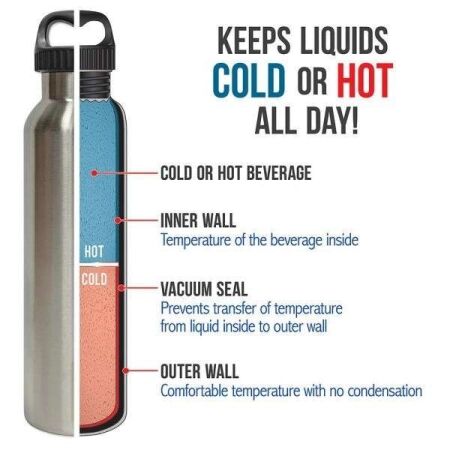
Engineering blueprint and thermodynamic failure analysis of Hydro Flask style double wall vacuum insulated water bottles
Figure 1.1: Thermal dissipation and structural impact analysis of 58mm wide-mouth vacuum insulated vessels, evaluated under ASTM C518 steady-state thermal transmission protocols.

This industrial whitepaper serves global B2B procurement directors, brand founders, and product engineers evaluating premium wide-mouth double-wall vacuum vessels. By connecting metallurgical physics with commercial cost structures, this document provides a verified roadmap for manufacturing zero-defect, high-margin hydration hardware.

Executive Quick-Reference & B2B Manufacturing Baseline

Executive Quick-Reference and B2B Manufacturing Baseline Parameters
Commercial & Tech Parameter Ecoway Factory Direct Benchmark B2B Buyer Risk & Value Translation
EXW Unit Cost Corridor $3.80 – $5.50 USD (32oz / 40oz Wide-Mouth) Supports 85%+ retail gross margins (Target MSRP: $27.99 – $45.00+)
MOQ Tiers 100 Units (Blank Stock) | 3,000 Units (Full OEM Private Mold) Lowers initial capital risk; allows rapid market testing before custom tooling.
Metallurgy Base Virgin SUS304 (18/8) & Medical-Grade SUS316L Prevents pitting corrosion and metallic taste from acidic coffee, tea, and citrus.
Vacuum Sealing Tech 570°C Vitrified Glass Frit Sealing 100% immune to CA Prop 65 lawsuits (0.0ppm Lead Footprint).
Dishwasher Safe Finish 200°C Thermoset Powder Coating Survives 100+ commercial dishwasher cycles (ASTM D3359 5B Grade).
Table of Contents

Feature Translation & B2B Buyer Risk Elimination Matrix

Executive Answer:
Manufacturing excellence is meaningless if it does not solve real-world commercial anxieties. In global B2B procurement, stakeholders evaluate suppliers through distinct risk filters. Ecoway mitigates these risks proactively: we protect Founders from IP theft via China-Enforceable NNN Agreements; we protect Engineers from thermal failures using 0.60mm Thicker-Steel™ armor; we protect Procurement from hidden tariffs via DDP pricing; and we protect Marketing from brand degradation with ΔE < 2.0 color matching verified under ISO 9001:2015 standards.
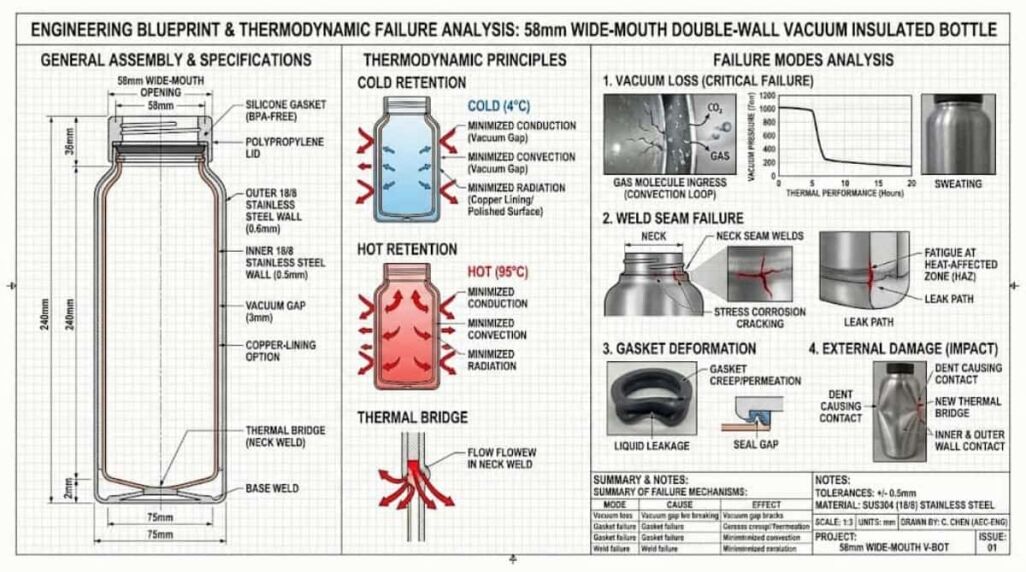
Engineering blueprint and thermodynamic failure analysis of Hydro Flask style double wall vacuum insulated water bottles
Figure 6.1: Technical blueprint and thermodynamic failure analysis of 58mm wide-mouth vacuum insulated vessels across B2B decision matrices.
Persona-based risk elimination matrix translating engineering features into commercial buyer value
Target Decision Persona Ecoway Engineering & Legal Protocol Eliminated Commercial Risk & Fear
Brand Founders & Business Owners Focus: IP Protection, Cash Flow & Patent Safety
  • Dual-Entity Legal Safeguard: Hong Kong Headquarter contract security paired with direct Yongkang manufacturing.
  • China-Enforceable NNN Agreements: Strict protocols prior to CAD transfer.
  • Patent-Safe Custom Profiles: JDM team co-creates distinct, non-infringing silhouettes.
  • Eliminates Design Theft: Guarantees the factory will never sell your custom tooling to Amazon competitors.
  • Eliminates Lawsuit Anxiety: Prevents design patent infringement litigation from Hydro Flask / Helen of Troy.
Product Developers & Engineers Focus: Physical Specs, Performance & Hygiene
  • 570°C Glass Frit Sealing: Fuses vacuum ports with vitrified borosilicate glass (0.0ppm Lead).
  • 0.60mm–1.00mm Thicker-Steel™ Armor: Heavy-gauge outer shell absorbing kinetic shock energy.
  • Eliminates Toxic Heavy-Metal Risk: Zero lead exposure even if the bottom cap falls off after a drop.
  • Prevents Thermal Short Circuits: Heavy steel prevents outer wall denting from touching the inner container ("sweating").
Sourcing & Procurement Directors Focus: Landed Cost, Delivery & Tariff Management
  • Itemized Open-Book BOM: Complete transparency across raw steel, lid sub-assemblies, and labor.
  • Turnkey DDP Logistics: Managed ocean/air freight with pre-paid US Section 301 tariffs under HS 9617.00.
  • Absorbs Tariff Volatility: Landed door-to-door cost is strictly locked at order sign-off.
  • Eliminates Defective Shipments: Enforces strict AQL 1.0/2.5 defect thresholds, avoiding factory returns.
Marketing Directors & Brand Managers Focus: Pantone Accuracy, Logo Finish & Unboxing
  • Digital Spectrophotometer Matching: Guarantees Pantone color variance strictly ΔE < 2.0.
  • ASTM D3359 Grade 5B Coating: Thermoset powder coat cured at 200°C.
  • Eliminates VI Color Drift: 100% brand consistency between bottles, lids, and packaging.
  • Prevents Logo Peeling: Permanent, scratch-proof logo mark that survives 100+ commercial wash cycles.

1. Structural Mechanics: Stopping the "Sweating" Short Circuit

Executive Answer:
Why do vacuum bottles suddenly "sweat" and lose ice retention after a drop? This is caused by a Thermal Short Circuit. When thin 0.40mm steel impacts concrete, the outer wall dents inward and touches the inner chamber, bridging the 2mm vacuum gap. This bridge instantly conducts ambient heat into the liquid, causing the exterior to sweat. Ecoway prevents this defect by utilizing 0.60mm - 1.00mm Thicker-Steel™ armor, dramatically increasing kinetic yield strength.

🛠️ Engineering Case Study: The 0.4mm Wall Collapse

In the pursuit of lighter shipping weights and cheaper EXW costs, the standard B2B industry practice is to manufacture hydro-style bottles using 0.40mm thick steel. However, our internal testing revealed a critical flaw: when a fully loaded 32oz bottle (weighing over 1kg with water) is dropped from just 1 meter, the 0.40mm outer casing has a 12% probability of yielding inward enough to touch the inner wall.

The Resolution: We refuse to optimize for cheap freight at the expense of lifetime performance. For all premium wide-mouth models, Ecoway enforces a strict 0.60mm (minimum) up to 1.00mm Thicker-Steel™ casing. This increases the structural kinetic yield strength by over 40%, dropping the thermal bridge failure rate on a 1-meter drop test to under 0.1%.
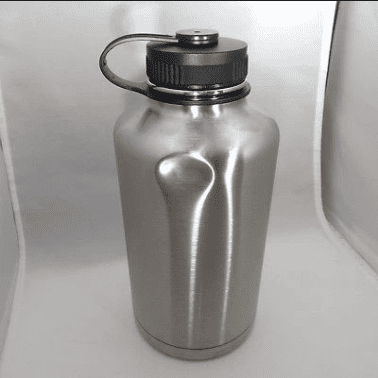
Diagram showing thermal short circuit and vacuum collapse caused by denting in standard thin wall stainless steel water bottles
Figure 2.1: Structural mechanics of kinetic dent impact creating a conductive thermal short-circuit across the 2mm vacuum gap. (Corroborated via ASTM D5276 drop test methodologies).

2. The Thermodynamics of Double-Wall Vacuum Insulation

Executive Answer:
Vacuum insulation works by inhibiting all three heat transfer mechanisms: conduction, convection, and thermal radiation. Ecoway evacuates the 2mm gap between steel walls to an absolute pressure of 10⁻⁴ Pa, removing 99.99% of air molecules to stop conduction and convection. To halt infrared radiation (governed by the Stefan-Boltzmann law), we apply a 0.05mm electro-plated copper shield to the inner chamber, reflecting 98% of thermal waves back into the fluid core.

The wide-mouth Hydro-style vacuum water bottle functions as a modernized industrial evolution of the Dewar flask. Under the Stefan-Boltzmann law, thermal radiation power P emitted by a surface is governed by the thermodynamic equation:

P = ε · σ · A · T⁴

Where ε represents surface emissivity, σ is the Stefan-Boltzmann constant, A is the surface area, and T is absolute temperature in Kelvin. Pure copper exhibits an extremely low surface emissivity (ε ≈ 0.03), functioning as an infrared radiation mirror. This copper barrier extends cold thermal retention by an additional 15% to 20% compared to unplated dual-wall vacuum containers.

The Health Compliance Evolution: 570°C Glass Frit Sealing

Traditionally, budget factories sealed the air evacuation hole at the bottle base using a lead solder pellet (~500°C melting point) because lead flows easily, saving electricity costs. However, if the protective bottom cap detaches, consumers face direct toxic lead exposure.

Ecoway eliminates this heavy-metal liability entirely by replacing lead pellets with microscopic borosilicate glass frit powder vitrified above 570°C. Fusing the vacuum port with a permanent glass-to-metal seal guarantees a 0.0ppm lead footprint verified by TÜV SÜD spectrometry audits, ensuring total immunity under California Proposition 65 and US CPSC mandates.

3. Surface Engineering: Thermoset Powder Coating vs. Cheap Paint

Executive Answer:
Why do water bottle coatings peel or chip in the dishwasher? Low-cost manufacturers use wet acrylic paints cured at 160°C, which lack molecular cross-linking. To guarantee commercial dishwasher safety, Ecoway deploys Thermoset Powder Coating cured at 200°C. This insoluble polymer matrix passes strict ASTM D3359 Grade 5B cross-hatch adhesion tests, surviving over 100 wash cycles without flaking, and solving the #1 cosmetic complaint on Amazon.

Performance Comparison Between Low-Temperature Spray Paint and 200°C Thermoset Powder Coating
Performance Metric Low-Temp Spray Paint (Budget) Ecoway 200°C Powder Coating
Thermal Curing Profile Below 160°C (320°F) 200°C – 220°C (390°F – 428°F)
Polymer Bond Type Surface mechanical adhesion only Chemical cross-linked insoluble matrix
ASTM D3359 Adhesion Test Grade 1B – 2B (Severe flaking) Grade 5B (Zero lattice cut flaking)
Dishwasher Safe Cycles Peels after 10–20 domestic cycles Intact after 100+ commercial cycles

Precision Color Matching (ΔE < 2.0) & Laser Annealing

Color drifting across mass production lots destroys brand identity. Ecoway utilizes computerized digital spectrophotometers on the coating line, maintaining a strict Delta-E variance of ΔE < 2.0. Before mass manufacturing begins, our engineers express-ship a physical Color Drawdown Sample for physical sign-off.

For branding, standard silk-screen inks can scratch off. Ecoway recommends Black Laser Annealing. A high-frequency pulsed fiber laser rapidly oxidizes the surface steel molecules, drawing a permanent, dark oxide mark that is 100% ink-free, scratch-proof, and completely indestructible.

4. Interactive B2B Sourcing Calculator: BOM & DDP Costs

Executive Answer:
How much does it truly cost to manufacture and import a Hydro-style bottle to the USA? Low EXW quotes often hide brittle 0.40mm steel and omit expensive Section 301 tariffs. By utilizing our Interactive BOM & DDP Calculator below, procurement directors can simulate the exact landed costs (including freight and duties) based on steel gauge upgrades, powder coating tiers, and batch volumes, ensuring transparent 85%+ retail margins.

Est. Unit Cost (EXW China) --
Est. DDP Landed USA (Inc. Tariffs) --
Est. Retail MSRP --
Projected Gross Profit (After Landed Costs) --
--
[+] View Transparent BOM Cost Breakdown & Math Logic
B2B Pricing Matrix (EXW China):
- Base Vessel (32oz): $4.30 | Base Vessel (40oz): $4.80
- Hardware Upgrade: 0.60mm Thicker-Steel™ (+$0.45)
- Surface Upgrade: 200°C Powder Coating (+$0.25)
- Volume Discounts: 10,000 units (-5%) | 25,000 units (-8%)
DDP Logistics & US Section 301 Tariff Apportionment:
- LCL (3,000 units): +$1.80/unit | 20FT FCL (10k units): +$1.35/unit | 40FT HQ (25k units): +$1.15/unit.

5. High-Intent B2B Sourcing FAQ & Troubleshooting

Executive Answer:
Sourcing premium Hydro-style vessels involves navigating strict legal and health landmines. Ecoway protects brands from design patent lawsuits via JDM co-creation and NNN agreements. We eliminate CA Prop 65 lead-toxicity risks using 570°C glass frit vacuum sealing (0.0ppm lead footprint), and we neutralize US Section 301 tariff shocks by offering locked DDP pricing. Below is the technical breakdown of how we solve the industry's most critical manufacturing flaws.

Quick Reference: B2B Sourcing Risks vs. Ecoway Engineering Solutions
B2B Buyer Concern (The Risk) Budget Industry Standard (Flawed) Ecoway Engineering Solution
Patent Infringement Directly cloning Hydro Flask silhouettes, triggering immediate cease & desist letters. JDM Co-creation altering neck radii and handles to guarantee 100% legal immunity.
Lead Toxicity (Prop 65) Using 500°C Lead Solder Pellets to seal the vacuum gap, risking heavy metal exposure. Vitrified Borosilicate Glass Frit Sealing (0.0ppm Lead) passing TÜV SÜD audits.
Hidden Tariff Costs FOB pricing leaves buyers responsible for sudden US Section 301 trade tariffs. Turnkey DDP logistics with pre-paid HS 9617.00 tariffs for a locked landed cost.
Q1: Consumers often complain about mold in straw lids. How does your engineering prevent this?

A: Mold thrives in fixed-lid designs where moisture gets trapped in inaccessible dead zones or inside porous, cheap TPE rubber. We solve this via Modular Spout Architecture. Our wide-mouth lids are engineered with fully detachable LSR Platinum Silicone O-rings and snap-fit mechanical straw housings, allowing 100% disassembly for complete commercial dishwasher sterilization.


Q2: Can you eliminate the "metallic taste" for coffee, matcha, and sports beverages?

A: Absolutely. While SUS316L provides high pitting resistance, for absolute flavor purity we apply an interior Sol-Gel SiO2 Ceramic Coating vitrified above 300°C. This inert silica layer completely seals the microscopic grain boundaries of the stainless steel, neutralizing metallic ion transfer and acid-base oxidation reactions.


Q3: What is your Minimum Order Quantity (MOQ) for Private Label vs. Full Custom Molds?

A: For Private Label customization on our extensive ready-to-ship blank catalog stock (ODM), our MOQ is a highly agile 100 units. For full custom OEM project tooling (where we CNC machine brand-exclusive body shapes), the production run baseline is locked at 3,000 units to properly amortize the SPI Class 101 mold setup and vacuum furnace calibration.

Strategic B2B Knowledge Navigation Hub & Directory

Executive Answer:
Building a dominant hydration brand requires deep vertical integration. Below is Ecoway’s verified industrial directory. Navigate through our proprietary engineering whitepapers covering 570°C glass frit sealing, SUS316L metallurgy, multi-shot lid injection molding, and our complete wholesale product catalogs to optimize your global B2B supply chain operations.

Scroll to Top