
B2B Drinkware Logistics Guide: DDP vs FOB, Air vs Sea & Dimensional Weight Costs

Executive Decision Summary: B2B Drinkware Shipping & Logistics

Executive Logistics Brief & Engineering Scope

Scope Declaration: This technical document strictly defines the global B2B supply chain logistics, cross-border freight architecture, and DDP/FOB incoterms specifically for OEM stainless steel vacuum insulated drinkware manufactured in Yongkang, China.

How do global B2B drinkware buyers optimize landed cost, transit time, and customs clearance when importing custom stainless steel bottles and tumblers? Procurement success requires balancing shipping modes against volume thresholds and volumetric displacement. For small pilot lots (<200 units), Air Freight DDP (5–10 days) secures rapid market testing; for scaling bulk runs (>500 units), Sea Freight DDP (25–45 days) or Matson Fast Sea (15–18 days) is mandatory to lock landed unit costs. Deploying DDP (Delivered Duty Paid) Incoterms eliminates surprise destination charges, pre-paying Section 301 tariffs and local VAT directly at the factory gate.
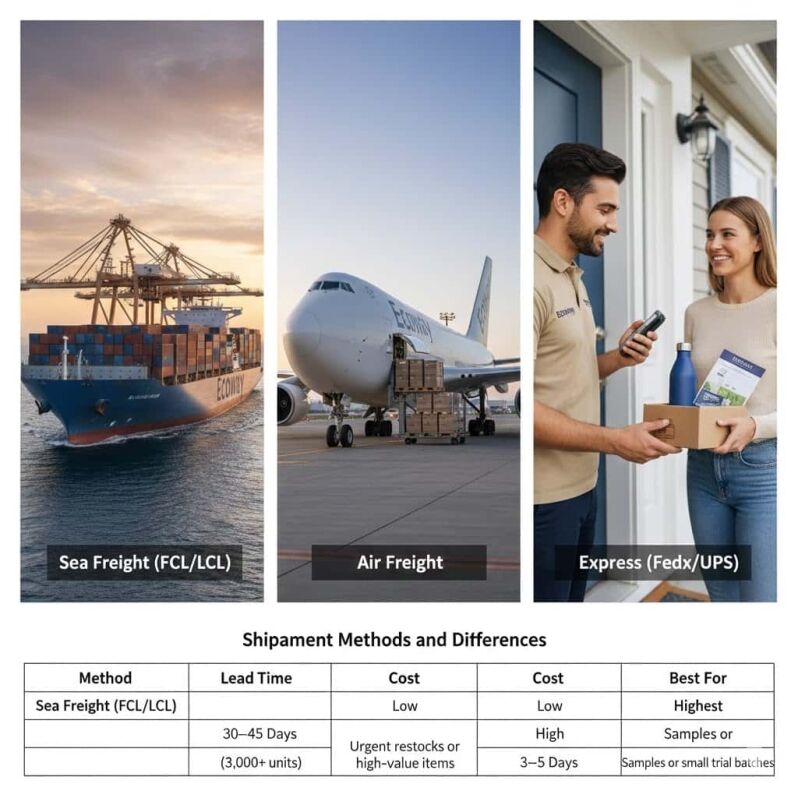
Multimodal shipping breakdown comparing DDP, FOB, Air Freight, and Sea Freight for custom stainless steel water bottles and tumblers
Figure 1.1: Comprehensive international trade infrastructure modeling comparing Incoterms across air (5-10 days) and maritime transport legs (25-45 days) for global stainless steel vessel distribution.

Managing international freight for stainless steel insulated drinkware demands precise financial and logistical modeling. At Ecoway Houseware, our pure-play B2B contract foundry synchronizes vertical manufacturing with factory-gate export packaging, automated FBA barcoding, and turnkey DDP logistics. Below, procurement teams and brand strategists can utilize our Interactive B2B Drinkware Freight & Transit Estimator to instantly calculate landed shipping metrics across global destination markets.

Interactive B2B Drinkware Freight & Transit Estimator

Select your destination market, drinkware profile, order quantity, and preferred shipping mode to estimate transit windows and unit landed freight costs:

Estimated Transit Window 25 - 35 Days
Est. Landed Freight / Unit $0.85 USD
Est. Total Freight Investment $425.00 USD
💡 Logistics Advisory: Standard Ocean Freight DDP provides the optimal cost-per-unit ratio for 24oz bottles, securing maximum retail margins.
Global Multimodal Shipping & Baseline Freight Rate Matrix

*Baseline freight rates and multimodal transit windows for global OEM drinkware supply chain planning. All metrics reflect direct factory-gate DDP terms.

Multimodal DDP Freight Rates and Estimated Transit Windows Across Key Destination Markets
Destination Region Air Express (Divisor 6000) Base Rate/Kg Air Express Transit (Days) Standard Sea DDP Base Rate/Kg Standard Sea Transit (Days)
North America (USA/CA) $10.5 USD/kg 5 - 9 Days $1.6 USD/kg 25 - 35 Days
Europe & UK $11.5 USD/kg 6 - 10 Days $1.8 USD/kg 35 - 45 Days
Australia & NZ $8.5 USD/kg 5 - 8 Days $1.3 USD/kg 20 - 30 Days
Southeast Asia $5.5 USD/kg 3 - 5 Days $0.8 USD/kg 10 - 15 Days
Middle East $9.5 USD/kg 6 - 9 Days $1.9 USD/kg 25 - 35 Days
South America $14.5 USD/kg 8 - 14 Days $2.8 USD/kg 40 - 50 Days
Supply Chain Logistics & Incoterms Baseline
Incoterms operational scope and commercial risk evaluation matrix for global drinkware sourcing
Incoterm & Shipping Option Operational Responsibility Scope B2B Buyer Value & Risk Translation
EXW (Ex Works) Factory gate pickup in Yongkang; buyer manages 100% of export/import logistics High buyer operational burden; best for large conglomerates with domestic China forwarders
FOB (Free on Board) Factory manages inland transit & export customs to Ningbo/Shanghai ports Standard for enterprise accounts managing ocean carrier contracts & destination brokers
DDP (Delivered Duty Paid) Factory manages 100% of transport, export/import clearance, tariffs, and door delivery Locks guaranteed landed unit cost; eliminates surprise destination tariffs & 3PL handling fees
20/80 Split Logistics Strategy 20% Air Express DDP for immediate launch + 80% Sea Freight DDP for bulk inventory Optimizes CCC (Cash Conversion Cycle); secures early pre-orders while protecting bulk margins
Table of Contents

Feature Translation & B2B Logistics Risk Elimination Matrix

International transport planning must directly eliminate commercial risk. In global B2B drinkware sourcing, different stakeholders evaluate shipping options through distinct financial and operational filters. Below is an itemized breakdown translating Ecoway’s logistics capabilities into direct risk reduction for four primary decision-makers:

B2B stakeholder feature translation and commercial supply chain risk mitigation matrix
Target Decision Persona Ecoway Logistics & Trade Protocol Eliminated Commercial Risk & Fear
Brand Founders & Business Owners Focus: Landed Cost Certainty, Margin Protection & Capital Lock
  • Turnkey DDP Landed Quotes: Fixed door-to-door unit pricing including ocean freight, customs entry, duties, and local drop.
  • Pre-Paid Section 301 Duty Handling: Automated tariff classification under HS 9617.00 vacuum vessel codes.
  • 20/80 Split Logistics Protocol: Air express pilot drop paired with cost-effective ocean bulk buffer.
  • Eliminates Surprise Freight Invoices: Prevents post-arrival tariff or port demurrage billing from eroding gross margins.
  • Optimizes CCC: Prevents capital lockup in long ocean transits during initial launch.
  • Protects Venture Capital Reserves: Locks fixed unit profitability prior to initial marketing expenditure.
Product Developers & Engineers Focus: Volumetric Displacement, Dent Protection & Packaging
  • Volumetric Weight Optimization: Master carton nesting engineering for 24oz bottles vs 40oz handled tumblers.
  • ISTA 3A Transit Testing SOP: Certified internal box dampening protecting 0.20mm lightweight walls.
  • ISPM 15 Fumigation-Free Pallets: Factory-built heat-treated wooden pallets built to Amazon FC height limits.
  • Eliminates Air Volumetric Billing Penalties: Prevents unexpected air freight charges caused by hollow handle dead space.
  • Prevents Transit Deformation & Scratches: Structural packaging protects powder coats across 3PL conveyor drops.
  • Eliminates Warehouse Pallet Rejections: Ensures 100% compliance with international shipping pallet rules.
Sourcing & Supply Chain Directors Focus: Amazon FBA Prep, Barcode Scannability & Peak Transit
  • Factory-Gate FBA Prep Integration: Inline FNSKU, ASIN, UCC-12 thermal barcoding & suffocation warnings.
  • 100% Optical Scanner Verification: Machine verification of all barcode quiet zones before carton sealing.
  • Matson Fast-Boat Sea Lines: Dedicated West Coast ocean routes cutting water transit to 15–18 days.
  • Eliminates 3PL Cross-Docking Overhead: Saves $0.80–$1.80/unit and compresses lead times by 14–21 business days.
  • Eliminates Amazon Inbound Chargebacks: Zero scanning failure penalties, forced rejections, or listing suspensions.
  • Protects Q4 Holiday Inventory Velocity: Fast-boat sea freight secures emergency restocking without high air costs.
Marketing Directors & Campaign Leads Focus: Campaign Launch Velocity, Event Timelines & UGC Unboxing
  • Agile Air Express DDP Drops: 5–10 business day transit for pre-orders, media seeding, and influencer PR.
  • ISTA Certified Gift Box Engineering: Rigid cylinder Kraft tubes & full-color CMYK boxes surviving courier drops.
  • Guaranteed Delivery Timelines: Locked shipment dispatch schedules aligned with trade show dates.
  • Eliminates Missed Marketing Windows: Guarantees product availability for PR campaigns, Kickstarter, or trade shows.
  • Prevents Unboxing Box Damage: Ensures pristine retail packaging upon delivery, driving 3x organic social UGC.
  • Accelerates Initial Customer Reviews: Early air units generate social proof while bulk ocean stock travels.
Lock Your Landed Cost & Shipping Strategy

Whether you need a custom DDP freight quote for 40oz handled tumblers, volumetric weight packaging optimization, or a 20/80 split shipping timeline for your upcoming product launch, our Yongkang logistics desk responds within 24 hours.

1. Cracking International Incoterms: Operational Realities of EXW, FOB, and DDP

When executing custom drinkware manufacturing agreements at our Yongkang facilities, looking past the base item fabrication rate is essential. International Commercial Terms (Incoterms 2020) determine the exact point where financial risk transfers, who controls export/import customs declarations, and who absorbs unexpected destination terminal fees or tariff adjustments.

Sourcing managers often fall into the trap of selecting initial factory quotes based solely on low EXW (Ex Works) or FOB (Free on Board) unit prices, only to discover that destination port handling, customs bonds, Section 301 tariffs, and local 3PL trucking fees add $1.50 to $3.50 per unit in unexpected backend overhead.

Incoterms Operational Comparison Table: EXW vs FOB vs DDP
Incoterm Rule Factory Responsibility Scope Buyer Responsibility Scope Financial & Legal Risk Point Ideal B2B Sourcing Application
EXW (Ex Works) Fabrication & master carton packing at factory gate 100% of inland China transit, export clearance, freight, duties, & door delivery Factory gate in Yongkang, Zhejiang Large conglomerates with private freight forwarders & China consolidation warehouses
FOB (Free on Board) Inland transit, export licensing, & loading onto vessel at Ningbo/Shanghai ports Maritime/air freight, destination port clearance, import tariffs, & final trucking When cartons clear the vessel's rail at export port Enterprise distributors running Full Container Load (FCL) volume with direct carrier contracts
DDP (Delivered Duty Paid) 100% of factory loading, export/import clearance, pre-paid tariffs, VAT, & door delivery Receiving sellable inventory at destination warehouse or Amazon FBA hub Upon final physical drop at buyer's destination warehouse gate DTC brands, Amazon FBA sellers, & gift buyers requiring a locked Landed Unit Cost
Operational Risk Breakdown by Incoterm

The Hidden Risks of EXW & FOB for Mid-Market Brands

Under EXW, your forwarder must navigate Chinese domestic trucking, export customs licensing, and port documentation. If export documents fail or customs inspections delay loading, your business incurs local demurrage and storage fees. Under FOB, while Ecoway handles domestic export formalities up to Ningbo or Shanghai port, your brand remains exposed to destination port congestion, unexpected US Section 301 tariff changes, and destination broker hold fees.

The Turnkey Advantage of DDP (Delivered Duty Paid)

Choosing DDP with Ecoway transforms an international import logistics chain into a simple, domestic-like transaction. Our logistics desk coordinates ocean or air transit, files automated entry documentation under verified HS 9617.00 vacuum vessel codes, prepays all Section 301 trade tariffs and European VAT/EORI fees, and delivers Amazon FBA-compliant pallets directly to your destination hub. The unit DDP price agreed in your contract is a Guaranteed Landed Price.

2. Multimodal Air vs. Sea Freight & The 20/80 Logistics Split Strategy

Transport mode selection dictates both landed margin and speed-to-market execution. While high-velocity Air Express provides immediate inventory availability, its high cost per kilogram compresses gross margins. Conversely, Standard Ocean Freight delivers the lowest cost per unit but requires a 25-to-45-day transit window that demands structured demand forecasting.

Multimodal Shipping Comparison: Air Express vs Fast Sea vs Standard Ocean Freight
Logistical Metric Air Express Freight (DDP) ✈️ Fast Sea Carrier / Matson (DDP) 🚤 Standard Ocean Freight (DDP) 🚢
Target Volume Scope Pilot Validation Lots (<200 units) or Emergency PR Drops Mid-Tier Scaling Lots (300 to 1,000 units) Mass Production Runs (1,000+ units to FCL)
Door-to-Door Transit Window 5 to 10 Business Days 15 to 18 Calendar Days (US West Coast) 25 to 45 Calendar Days (Global Ports)
Landed Unit Freight Impact High ($4.50 – $14.00+ / unit depending on shape) Moderate ($1.80 – $3.50 / unit) Baseline ($0.45 – $1.20 / unit)
Customs Entry Channel Express Air Courier Pre-Cleared Entry Express Pier Terminal Customs Clearance Integrated Consolidated Container DDP Bond
Impact on Gross Margin Compresses margin by 15% – 30% Balanced margin impact Maximizes retail gross margins (85%+)
Industrial Growth Blueprint: The 20/80 Logistics Split Strategy

To prevent Q4 holiday stockouts while protecting gross margins, Ecoway’s supply chain desk recommends deploying the 20/80 Logistics Split Strategy for new product launches:

20/80 Logistics Split Strategy diagram showing air express pilot shipping paired with bulk ocean container freight
Figure 4.1: Synchronizing 20% Air Express pre-orders with 80% Sea Freight ocean buffers to accelerate CCC (Cash Conversion Cycles).
  • Step 1 (20% Air Express Allocation): Ship 20% of your mass production run via Air Express DDP. This early stock arrives at your warehouse in 5 to 10 days, allowing your team to immediately fulfill pre-orders, seed media and influencer campaigns, and capture early customer reviews on Amazon or Shopify.
  • Step 2 (80% Ocean Freight Allocation): Simultaneously, route the remaining 80% bulk balance via cost-effective Sea Freight DDP. This ocean cargo arrives in 25 to 35 days, perfectly timed to restock your distribution channels just as initial launch sales surge, keeping your average landed unit cost low and safeguarding liquidity.

3. The Dimensional Weight Volumetric Trap & ISTA 3A Packaging Economics

A frequent financial mistake made by sourcing managers is calculating air freight budgets based solely on actual scale weight (kg). International air carriers bill according to Chargeable Weight, which is the greater of actual weight versus Volumetric (Dimensional) Weight calculated via carrier-specific divisors:

Standard Air Cargo Volumetric Weight (kg) = Length (cm) × Width (cm) × Height (cm) 6000
Express Courier (DHL / UPS / FedEx) Volumetric (kg) = Length (cm) × Width (cm) × Height (cm) 5000
⚠️ Express Courier Cost Penalty: Using express couriers (divisor 5000) triggers a 20% higher chargeable weight penalty compared to standard air cargo freight (divisor 6000).

Because air cargo space is finite, hollow or protruded shapes incur a severe volumetric billing penalty. Understanding how vessel geometry affects master carton packaging density is critical before choosing shipping modes.

Volumetric Air Freight Cost Penalty Comparison Table: Sleek Bottle vs Handled Tumbler
Product Profile & Dimensions Carton Master Packing Density Actual vs Billed Air Weight / Unit Air Freight Cost Penalty Impact
24oz Sleek Cylindrical Bottle
Slim profile, no handle protrusions
50 Pcs / Master Carton
Dense nesting, minimal dead space
Actual: 0.38 kg
Billed Volumetric: ~0.45 kg
Minimal Penalty ($4.50 – $5.50 Air Freight / Unit)
40oz Travel Tumbler with Handle
Tapered base + plastic handle protrusion
24 Pcs / Master Carton
Protruding handles create severe dead space
Actual: 0.65 kg
Billed Volumetric: ~1.25 kg
~90% Air Volumetric Penalty! ($11.00 – $14.00 Air Freight / Unit)
ISTA 3A Structural Packaging: Protecting Light Steel & Powders in Transit

When distributing vessels engineered with ultra-lightweight 0.20mm to 0.30mm cup wall thickness or premium 200°C thermoset powder coatings, inadequate internal packaging leads to container denting and surface scratches during automated 3PL conveyor drops.

Ecoway operates an in-house packaging lab that calculates mass deceleration profiles to design custom internal cardboard dampeners and rigid Kraft gift tubes through our custom packaging services. Every custom packaging configuration undergoes simulated transit testing, achieving certified ISTA 3A drop-test compliance. This structural protection ensures zero transit deformation across long ocean voyages and courier delivery loops.

4. Cross-Border Regional Transit Windows & Customs Compliance Protocols

Distributing custom stainless steel vessels into international commercial centers requires deep integration with regional tax codes, tariff schedules, and food-contact compliance frameworks. Ecoway maintains secure, door-to-door tax-cleared DDP logistics routes across key target regions to protect inventory velocity.

🇺🇸 North America (USA & Canada)

Standard ocean freight DDP routing averages 25 to 35 calendar days door-to-door. For urgent inventory drops or Q4 holiday restocking, our logistics desk secures dedicated space on premium Matson fast-boat shipping lines, reducing West Coast port-of-entry transit down to an efficient 15 to 18 days window. All US shipments are cleared under verified HS 9617.00 vacuum vessel codes, with pre-paid Section 301 tariffs, FDA 21 CFR 177.1240 compliance, and California Proposition 65 zero-lead certification.

🇪🇺 🇬🇧 Europe & The United Kingdom

Ocean distribution loops span 35 to 45 calendar days into major European and UK container ports. Our structured European DDP quotations provide a complete financial shield by pre-paying all destination VAT and EORI customs entry fees at port-of-entry hubs, preventing unexpected secondary terminal handling fees, port demurrage, or border holding complications while ensuring LFGB food-grade compliance.

🇦🇺 🇳🇿 Oceania (Australia & New Zealand)

Maritime transport routes average 20 to 30 calendar days. Due to direct geographic proximity to our Zhejiang shipping ports, Less-than-Container Load (LCL) and Full Container Load (FCL) sea freight lanes provide excellent cost-per-unit performance for Southern Hemisphere retail markets.

🇯🇵 🇰🇷 East & Southeast Asia / Middle East

Near-source maritime lanes deliver units within 5 to 10 business days across East Asia and 18 to 25 days into Middle Eastern distribution hubs. All Asian shipments pre-validate factory production allocations against regional food-grade safety mandates, including full Japan Food Sanitation Law (JFSL) laboratory certifications.

5. High-Intent B2B Sourcing & Customs FAQ Directory

Below are direct, authoritative answers to critical logistics, tariff, and volumetric shipping questions asked by global B2B procurement buyers during factory evaluation:

Q1: Why is air shipping a 40oz handled tumbler so much more expensive than a 24oz bottle?

A: Air freight carriers charge based on Chargeable Weight, which is the greater of actual weight versus Volumetric Weight (Length × Width × Height / 6000). A 40oz tumbler with a protruding side handle prevents tight nesting inside master cartons, creating significant dead space and roughly doubling the volumetric displacement per item (~1.25 kg billed air weight vs 0.65 kg actual scale weight). For a sleek 24oz cylindrical bottle, nested packing minimizes carton dead space completely. To avoid severe volumetric penalties, sourcing experts strictly route handled tumblers via cost-effective Sea Freight DDP.

Q2: As a new brand, should I choose FOB or DDP for my first container of drinkware?

A: For startup DTC brands, e-commerce sellers, and mid-market growth enterprises, we strongly recommend DDP (Delivered Duty Paid) terms. Under traditional FOB terms, your brand absorbs unpredictable maritime rate spikes, destination port handling fees, complex customs bonds, and variable import tariffs. Choosing DDP with Ecoway provides a contract-guaranteed, locked Landed Cost per unit, as our logistics desk manages all export/import documentation, Section 301 tariffs, and door-to-door delivery.

Q3: How long does sea freight take from China factory to the USA, Europe, or Australia?

A: Standard Door-to-Door DDP sea freight routing averages 25 to 35 calendar days to the United States and Canada, 35 to 45 calendar days to European and UK port-of-entry hubs, and 20 to 30 calendar days to the Oceania market. For urgent North American inventory drops, Ecoway secures dedicated space on premium Matson fast-boat shipping lines, slashing ocean transit times to West Coast terminal gates down to an efficient 15 to 18 days window.

Q4: Are import duties, Section 301 tariffs, and VAT included in my DDP shipping quote?

A: Yes. While EXW or FOB factory quotes explicitly exclude destination tariffs and local taxes (which are billed separately by destination customs brokers), an official DDP contract from Ecoway Houseware completely covers all cross-border clearance expenses, automated entry filings under verified HS 9617.00 vacuum vessel codes, Section 301 trade tariffs, and European VAT/EORI obligations, ensuring zero unexpected secondary invoices upon warehouse arrival.

Q5: What is the "20/80 Logistics Split Strategy" for launching a new drinkware line?

A: The 20/80 Logistics Split Strategy balances speed-to-market with capital efficiency. Brand managers route 20% of their mass production run via express Air Freight DDP to instantly fulfill pre-orders, execute media seeding campaigns, and accumulate early customer reviews. The remaining 80% bulk balance simultaneously travels via cost-effective Sea Freight DDP, arriving at your warehouse just as early validation sales conclude, lowering average landed unit cost and protecting liquidity.

Scroll to Top