
Executive Briefing: Why Coatings Peel & How to Fix It
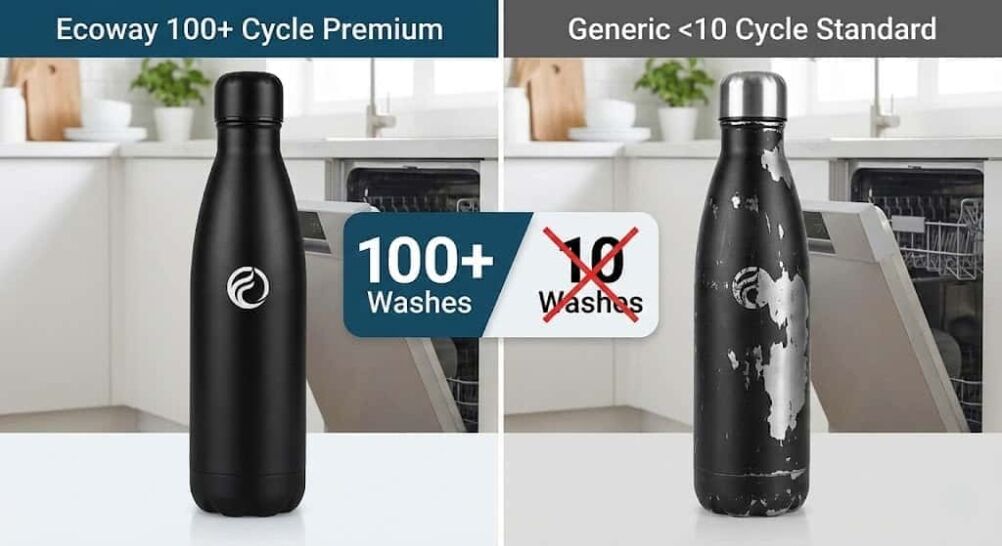
Direct Answer for Brand Owners & CPOs: Why do tumbler coatings peel after a few weeks of use? Budget factories often skip the crucial physical sandblasting pre-treatment on smooth stainless steel to cut costs. Furthermore, they apply low-temperature, ultra-thin layers of cheap powder. For premium drinkware to survive the harsh alkaline detergents and high heat of modern dishwashers, it requires proper electrostatic powder coating cured at 200°C for -. This creates a chemical cross-linking bond, achieving a Grade 5B on the ISO 2409 / ASTM D3359 cross-cut adhesion test, ensuring a genuine Dishwasher Safe metric.
1. The Evolution of Tumbler Coatings & The "Cheap Factory" Pitfall
The perception of premium drinkware has drastically shifted over the past decade. The trend of matte finishing gained momentum around , heavily influenced by the rise of outdoor brands and Hydro Flask style wide-mouth bottles. Consumers loved the tactile grip, but early spray-painted matte finishes were notoriously fragile—unable to withstand dishwashers and prone to peeling within six months of normal use. Glossy spray paint fared slightly better due to clear varnish topcoats, but the market demanded matte aesthetics combined with industrial durability.
The tipping point occurred in when the massively popular Yeti style tumblers established durable Electrostatic Powder Coating as a non-negotiable feature for premium drinkware. By , full-automatic electrostatic lines enabled multi-color gradient (ombre) powder coatings, pushing the boundaries of customization.
When hotel chains, fitness brands, or coffee shops launch a line of custom retail cups, the marketing team or founders are often the driving force. However, what looks visually identical on a pre-production sample can be a ticking time bomb in terms of quality. In a race to the bottom on pricing, many budget factories resort to dangerous cost-cutting tactics:
1. Reducing Coating Thickness: Standard powder coating requires a 60μm to 100μm thickness. Cheap suppliers halve this to save powder volume.
2. Inferior Resins: Using cheap, non-alkaline-resistant powder that blisters after fewer than 10 dishwasher cycles.
3. Low Curing Temperatures: Rushing the baking process below 200°C, meaning the powder never cross-links properly into the steel's pores.
This discrepancy translates consumer complaints ("the paint is peeling") directly into high return rates, Amazon negative review cascades, and the destruction of the brand premium you worked so hard to build.
2. Decoding Dishwasher Standards: EN 12875 vs. ASTM D2248
"Dishwasher Safe" is not a marketing buzzword; it is a strictly quantifiable metric. For CPOs and compliance officers, understanding the difference between regional testing protocols is the first step in avoiding catastrophic product recalls and negative brand sentiment.
🇪🇺 The European Standard: EN 12875
Europe utilizes EN 12875-1 / EN 12875-2 for household utensils.
The Baseline: 20 wash cycles. This is the minimum threshold to legally claim "Dishwasher Safe" in the EU.
The Premium Tier: High-end retailers (e.g., IKEA, Zwilling) mandate 125 to 250 cycles. The coating must show zero blistering, cracking, or color deviation under visual inspection.
🇺🇸 The US Standard: ASTM Protocols
While the US lacks a single statutory law for cycle counts, industry giants set the pace using ASTM D2248 (Detergent Resistance).
The Baseline: Amazon and big-box retailers generally accept 20 cycles.
The Yeti/Stanley Standard: Top outdoor brands demand 50 to 100 cycles. More importantly, immediately after the wash, the tumbler must pass the ASTM D3359 Cross-Cut Adhesion Test, achieving a 4B or 5B rating (virtually zero paint removal).
⚙️ Engineering Insight: The Stainless Steel Dilemma
Unlike carbon steel, stainless steel possesses a highly smooth surface with a natural passivation layer. Without rigorous physical pre-treatment (sandblasting) or chemical silanization to create microscopic roughness, water vapor easily penetrates the barrier during a high-heat dishwasher cycle. This causes the entire coating layer to detach in sheets—a fatal flaw we eliminate on our automated manufacturing lines.
3. Ecoway's "No Cheat" Tiered Supply Chain Solutions
Because a $3.00 factory wholesale tumbler simply cannot absorb the costs of a world-class aerospace-grade coating, honesty in B2B sourcing is paramount. We provide two distinct tiers of genuine, validated dishwasher-safe finishes, ensuring brand owners get exactly what they specify without hidden shortcuts.
The Ultimate 100+ Cycle Standard (PFAS-Free)
MOQ High / Premium CostFor tier-one outdoor brands looking to outlast the competition, we partner with industry behemoths like PPG, Tiger Drylac, and Axalta. Notably, PPG's proprietary formulations are among the only solutions projected to remain strictly PFAS-Free ahead of the global regulatory crackdowns.
- The Commercial Reality: Applying this top-tier powder adds $0.50 to $0.80 to the unit BOM cost (compared to a $0.15 standard spray).
- MOQ Constraints: Because global powder manufacturers do not mix small custom color batches, this tier requires a strict MOQ of 5,000 to 10,000 units per color.
The Premium 20-50 Cycle Standard (Hospitality/Retail)
MOQ 1,000pcs / High ROINot every brand requires a bottle capable of surviving 100 industrial washes. For luxury wellness retreats, fitness franchises, and coffee chains, Ecoway provides an uncompromising "honest standard." We proudly supply custom guest water bottles to renowned hospitality properties like CIVANA Carefree Resort, directly enhancing their guest experience and brand prestige.
- The "No Cheat" Promise: Even for our 20-50 cycle tier, we strictly enforce a 200°C baking process and utilize proper physical sandblasting. We do not thin the coating to save pennies.
- Invisible Quality Hubs: We safeguard your brand reputation holistically. These bottles utilize true verifiable metallurgy—explore our SUS304 vs SUS316 material breakdown to see why we ban rust-prone alloys—and are paired with shatter-resistant Tritan™ lids, ensuring the entire product matches the premium feel of the coating.
4. 1D Data Matrix: Tumbler Coating Cost & Compliance
| Surface Finishing Type | Avg. Added Cost (BOM) | Tested Dishwasher Cycles | Target B2B Brands & Compliance |
|---|---|---|---|
| Cheap Liquid Paint (Matte) No sandblasting / Low heat | $0.15 - $0.25 | < 10 Cycles (Peels Rapidly) | Flea markets, ultra-budget promos. Extremely high Amazon return rate risk. |
| Ecoway Premium Powder Coating Sandblasted / 200°C / Standard ISO 2409 | Included in Base Price | 20 - 50 Cycles | Luxury Hotels (e.g., CIVANA), Gyms, Retail. Meets baseline EN 12875 household limits. |
| PPG / Tiger PFAS-Free Powder Global Leader / Extreme Bond | +$0.50 - $0.80 | 100+ Cycles (ASTM D2248 Pass) | Top-Tier Outdoor (Yeti/Stanley alternatives). PFAS-Free compliant. MOQ 5K+. |
Stop losing customers to peeling coatings. Contact our engineering team for a full DFM analysis, precise PPG / Tiger powder cost breakdowns, and custom hotel/brand OEM solutions within .
5. FAQ: Dishwasher Safety & Powder Coating Facts
Why does Matte powder coating peel faster than Glossy paint in some budget tumblers?
Why does PPG PFAS-Free Powder Coating require a 5,000+ MOQ?
How does logo customization survive 100 dishwasher cycles?
How does your 100% mold fee refund policy work?
What is the typical OEM lead time for a new bottle design?
As the Head of Marketing and JDM Engineering at Ecoway Houseware Limited, Van Huang bridges the gap between commercial brand strategy and hardcore metallurgy. He personally established the EN 12875 / ASTM D3359 cross-cut adhesion laboratory within the Yongkang manufacturing facility. By managing direct supply chain negotiations with PPG for PFAS-Free formulations, Van ensures that all B2B OEM clients—from luxury hospitality brands to heavy-duty outdoor gear companies—receive zero-defect, true 100-cycle dishwasher-safe products. All commercial projects are protected by a legally binding Printable NNN Agreement.