
Direct Answer for B2B Sourcing: What is 0.90mm - 1.00mm Ultra-Thick Steel Drinkware?
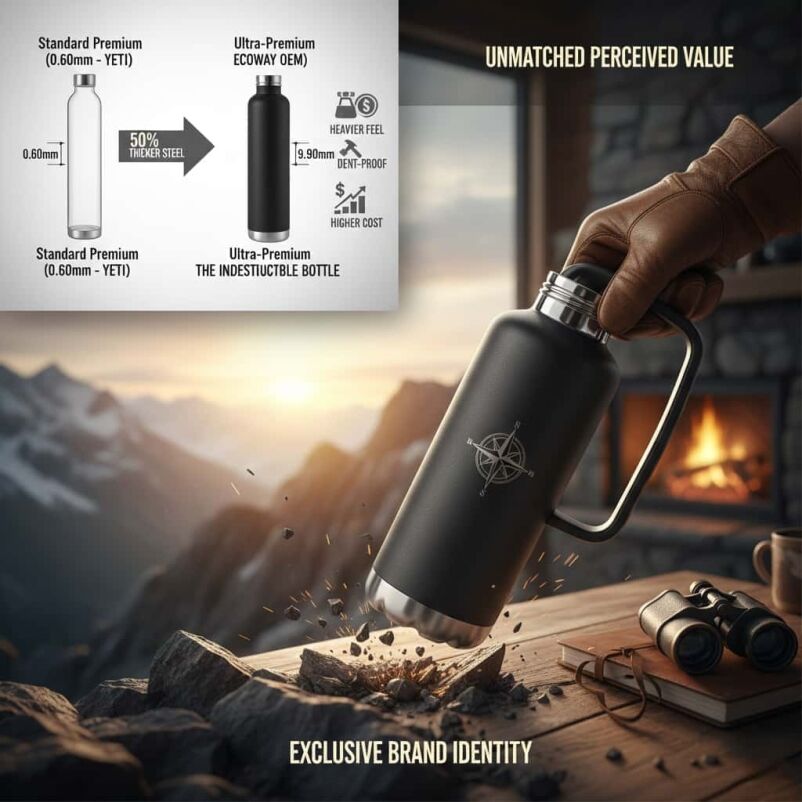
In the competitive vacuum insulated drinkware market, outer wall thickness dictates market positioning and brand survival. While standard brands utilize a 0.50mm outer wall, and ultralight Japanese markets drop to a fragile 0.40mm, premium outdoor leaders like YETI dominate by using a 0.60mm - 0.65mm shell to create "Premium Haptic Feedback" (Weight = Value). To out-compete these legacy giants, Ecoway Houseware engineered the 0.90mm to 1.00mm Ultra-Thick Steel Standard (successfully deployed in projects like the Cirkul 32oz metal water bottle). This brute-force engineering eliminates dent-related consumer returns, provides indestructible drop resistance, and physically prevents "vacuum bridging" (where dented outer walls touch the inner chamber, permanently destroying thermal retention).
If your strategic goal for is to build a "Heritage Class" outdoor brand, competing on price with flimsy, lightweight bottles is a race to the bottom. Instead, the winning formula lies in aggressive material engineering. By intentionally increasing the physical mass of your product, you instantly communicate top-tier luxury, ruggedness, and uncompromised durability to the end consumer.
The Invisible Moat: Beyond Standard "Premium" Drinkware
When founders begin designing premium drinkware to rank among the "Top 10 Best Water Bottles" on the market, the discussion typically revolves around highly visible features. Brands demand internal copper lining for maximum thermal retention, metal-taste-free ceramic coatings, shatter-proof BPA-free Tritan™ plastic lids, and extremely resilient 100-cycle dishwasher safe powder coating.
While these specifications are critical to passing rigorous international safety frameworks—such as the CPSC certification guidelines for consumer safety or the ASTM A240 standards for stainless steel metallurgy—they are no longer unique. They are merely the baseline requirements for entering the B2B high-end market. The most defining, yet frequently ignored factor by new sourcing directors is the physical thickness of the outer steel shell.
⚠️ The B2B Translation: Why C-End Dents Destroy B2B Margins
When a standard 0.5mm water bottle drops on a hiking trail, it suffers a severe structural dent. To the consumer, this is a ruined aesthetic. To the B2B brand owner, this triggers a catastrophic chain reaction:
The dent forces the outer shell inward until it physically contacts the inner chamber. This creates a "Thermal Bridge," entirely bypassing the vacuum insulation. A bottle designed to keep ice for now sweats condensation in minutes. This leads to 1-star Amazon reviews, skyrocketing return rates, and a severely degraded brand reputation.
To completely eliminate this failure point, Ecoway Houseware pushed the boundaries of seamless deep drawing forming technology. By manipulating ultra-thick virgin 18-8 SUS304 and SUS316L stainless steel plates up to 1.00mm gauge, we give B2B brands the manufacturing firepower to build a genuinely indestructible product—elevating your brand far beyond standard retail competitors.
The "Yeti Strategy" & The Next Leap: 1.0mm Super-Heavy Tanks
Before , standard vacuum bottles manufactured in China utilized a 0.50mm outer wall. While functional, they felt lightweight and "tinny." YETI disrupted the industry by upgrading their outer steel thickness to 0.60mm - 0.65mm. Consumers picked up the cup and immediately felt the solid mass. This "Weight = Value" haptic feedback allowed them to establish an ultra-premium positioning. If you are a Yeti-style tumbler alternative brand, this 0.60mm spec is your absolute minimum baseline.
However, to dominate the market in , you must out-engineer the leaders. Ecoway Houseware has pushed the limits of heavy-tonnage hydraulic forming to process 0.90mm to 1.00mm outer steel plates.
- Standard Industry Spec: Inner 0.40mm / Outer 0.50mm (High risk of side-wall denting).
- Premium Yeti Standard: Inner 0.40mm / Outer 0.60mm (Solid baseline for outdoor gear).
- Ecoway "Heritage" Spec: Inner 0.40mm / Outer 1.00mm (Indestructible tactical durability).
🚀 OEM Case Insight: Cirkul 32oz Metal Water Bottle
Ecoway Houseware's engineering team successfully executed this ultra-thick strategy when collaborating with top-tier hydration brands. For projects like the heavy-duty 32oz metal water bottle segments, we applied 0.90mm - 1.00mm outer walls. When a consumer taps the side of this 1.0mm bottle, it doesn’t "ping" like a hollow tin can; it "thuds" like a heavy-duty tool. This auditory and tactical feedback creates a flawless unboxing experience and positions the product directly into the $60-$80 MSRP luxury tier.
Thermodynamic Facts & The "Ultralight" Dilemma
When you increase the outer shell thickness to 1.00mm, you inadvertently upgrade the bottle's thermal dynamics. According to our thermal performance testing standards (which require retaining ice for and hot liquids for ), the sheer mass of the steel plays a crucial role in field environments.
The Advantage: Thermal Mass Buffering
A 1.0mm wall acts as a secondary heat buffer. In direct sunlight, the massive outer shell absorbs and disperses ambient thermal energy before it can penetrate the vacuum gap, yielding up to a 10% boost in temperature stability. More importantly, its rigidity completely prevents structural collapses that cause inner and outer walls to touch—the #1 cause of vacuum failure.
The Trade-off: The Japanese Ultralight Trap
Thicker steel means heavier products. In markets like Japan, consumer preference leans heavily toward "Ultralight" designs (0.25mm - 0.30mm spinning tech). Launching a 1.0mm heavy-duty bottle for Japanese urban commuters will fail. The 1.0mm spec is strictly an offensive weapon for the North American and EU rugged outdoor / tactical markets.
Procurement ROI: 1D Cost & Performance Matrix
Honest OEM engineering requires transparency. Upgrading from the standard 0.5mm shell to the 1.0mm "Tank" spec involves specific BOM (Bill of Materials) adjustments. While standard manufacturing costs for a 24oz bottle range from $3.60 to $4.80, the extra raw steel and high-energy laser welding requirements will shift your unit economics. Here is the B2B decision matrix:
| Engineering Metric | Standard OEM (0.5mm) | Premium Standard (0.6mm) | Ecoway Ultra (1.0mm) |
|---|---|---|---|
| Drop Resistance (Dent) | Low (High Return Risk) | High (Solid Daily Use) | Extreme (Indestructible) |
| Product Weight Profile | Lightweight | Moderate Heft | Heavy-Duty (Tactile Value) |
| BOM Cost Variance | Baseline ($3.60-$4.80) | +5% to +8% | +15% to +20% |
| Optimal Target Market | Promotional / Supermarket | Lifestyle / Basic Outdoor | Tactical / Luxury Heritage |
🚀 Build Your "Tank" Collection
Manufacturing with 1.00mm steel requires specialized high-power fiber laser welding and precision hydraulic presses that standard factories lack. Ecoway Houseware is equipped for this "Super-Heavy" standard with a proven 165-Day OEM Roadmap.
Engineering FAQ: 1.0mm Steel Manufacturing
Is it harder to manufacture a vacuum in a 1.0mm thick bottle?
Can 1.0mm thick bottles be customized with standard laser engraving?
Does the extra thickness impact the external temperature of the bottle?
What is your MOQ and tooling cost for a custom ultra-thick mold?
How do you protect our proprietary heavy-duty bottle design?
Deep Dive: Heavy-Duty Engineering & Sourcing
Move beyond standard bottle specs. Explore the exact material science, production technologies, and ROI calculations required to build a premium hydration brand.
Material Science
Production Technology
With over a decade of factory-floor experience in Yongkang, Van leads the engineering execution for premium hydration brands. His expertise specifically encompasses high-gauge steel hydroforming limitations, calculating 10⁻⁴ Pa thermodynamic buffering data, and scaling heavy-duty 0.90mm-1.00mm OEM projects without compromising deep-drawing yield rates.